
Maintain a positive attitude and stay motivated throughout your preparation. Take regular breaks and engage in activities that relax and rejuvenate you.
 Edinbox
 Blog
Edinbox
Edinbox Blog
Maintain a positive attitude and stay motivated throughout your preparation. Take regular breaks and engage in activities that relax and rejuvenate you.
Global Media Common Entrance Test https://gmcet.org/ is India’s First National-Level Entrance Exam for media, journalism, and mass communication. It is powered by EdInbox, South Asia’s largest education-focused platform. It is considered India’s largest undergraduate media aspirant base.

MBBS in Georgia is among the options Indian medical aspirants consider after NEET when they are unable to secure a preferred medical seat in India. Several universities in Georgia offer medical programmes taught in English, with many following a six-year, single-cycle structure. Indian students should, however, verify the foreign medical education requirement of the National Medical Commission (NMC) and the curriculum, clinical training and eligibility of the university before applying for admission.
The total cost of studying medicine in Georgia also depends on the particular university and lifestyle. The provided 2026 fee information puts tuition somewhere in the range of USD 5,000–8,000 per year, with extra costs like housing, meals, insurance, travel and other living expenses being factored out separately. Students should confirm the latest fee structure directly with the university before making any payment.
MBBS in Georgia for Indian students generally involves a six-year medical programme, although the exact course structure and fees vary by university. Based on the fee information considered for 2026, annual tuition can range from around USD 5,000 to USD 8,000, excluding living expenses. Indian students should also check NEET requirements and the National Medical Commission's foreign medical graduate rules before choosing a university.
Generally, the price of studying medicine in Georgia for Indian students is composed of tuition fees and living expenses. Based on the fee information available, annual tuition can range from approximately USD 5,000 to USD 8,000, depending on the university and programme. Students should confirm the current fee directly with the institution before making any payment.
At these annual tuition rates, six years of tuition would amount to approximately USD 30,000–48,000, excluding accommodation, food, insurance, travel and other expenses. Final charges in Indian rupees will be based on the exchange rate and any increase in University charges throughout the course.
Additional costs covered are living expenses. Students have to plan for their housing, meals, local transportation, travel between India and Georgia, and insurance costs. The estimates given above for the cost of living range from ₹25,000–55,000 per month, but this can vary from city to city and lifestyle to lifestyle.
There are a number of universities in Georgia that provide medical programmes in English. Examples of Georgian universities offering medical education include Tbilisi State Medical University, the University of Georgia, European University, David Tvildiani Medical University, Caucasus International University and Grigol Robakidze University. Students should verify the current programme, accreditation status, tuition fee and admission requirements directly with each university before applying.
Students must not choose a university because of an advertised annual fee, however. NMC explicitly recommends Indian students to check the duration of the course, medium of instruction, syllabus and course curriculum, clinical training and internship arrangements before applying for an admission to the foreign medical education.
NEET qualification is a crucial criterion for an Indian student who wants to pursue his medical education abroad and later, register as a physician in India. Students should be able to differentiate between the admission criteria that a Georgian university has and an Indian graduate has to meet to practice medicine in India.
Admission requirements for the university or college may vary. NEET has not been mandated for admission to TSMU itself, according to Tbilisi State Medical University, but it has mentioned that students from countries like India might require NEET for licensing after completing studies at TSMU.
This is why it is advisable to students to not assume that a university's admission requirement is the deciding factor for whether or not the degree is suitable for practice in India.
Specific requirements may differ from one university to another. For Indian students, the provided details specify that going for Class 12th with Physics, Chemistry and Biology along with NEET qualification, age requirements and documents are the key factors.
Please see the university's current admission page for the precise marking requirement, language requirements and document list prior to applying.
Requirements for English language proficiency may vary as well. The University of Georgia for example, admits students whose English language information is at B2 and determines this level of English using an examination, if a certificate is not offered. The international applicants' current FAQ at Tbilisi State Medical University states that the applicant shall have at least B1 level of English proficiency certified by an internationally recognized certificate.
So, it is not correct to refer to the blanket statement that “IELTS/TOEFL is not required” for all Georgian medical universities.
Most medical courses in Georgia have a single cycle of six years' duration. For instance, the University of Georgia offers Medicine that is taught in English and has a duration of 6 years and a total of 360 ECTS.
For Indian students, however, the duration alone is not enough to establish eligibility for medical registration in India. The NMC advises students to verify that the foreign medical programme meets the applicable FMGL requirements, including course duration, clinical training and internship arrangements.
The most important step is to verify the specific university and programme, rather than relying on general claims about “MBBS in Georgia.”
Students should check the following before paying any admission or tuition fee:
The NMC has specifically warned students that non-compliance with foreign medical education requirements can affect their ability to obtain registration in India.
As per the current data available, the Georgian medical tuition is less than those for many private medical colleges in India. There is however, no fixed fee which can be applied to Georgia or private medical colleges in India and a blanket comparison may be misleading.
Students should not compare the annual tuition, but the total cost of six years which includes tuition, accommodation, food, travel, insurance and other expenses. The decision should also consider the regulatory requirements for returning to India. A lower advertised fee does not automatically make a foreign medical programme the better option.
Indian students aspiring to practice medicine in India must comply with the relevant licensing and registration norms for Indian doctors after earning their foreign qualification in medicine. Depending on the changing Indian medical education scenario, examination and internships norms may vary.
The recently issued NMC advisory clearly indicates that students need to make sure about the norms before admission into such universities rather than taking admission assuming automatic registration in India post their foreign medical qualification.
Georgia is one option for Indian students seeking a medical program in English overseas, especially when comparing cost and other aspects of admission processes between various countries. However, the final decision should depend on the specific cost of each university, the nature of its practical experience, legal requirements, and the future plan of the candidate.
Thus, it is advised to check the current NMC requirements and the university's official programme details before signing an admission agreement or transferring money. For the 2027 intake, students should also verify the latest fee schedule and admission deadline directly with their shortlisted university, as fees, intake dates and admission conditions can change.
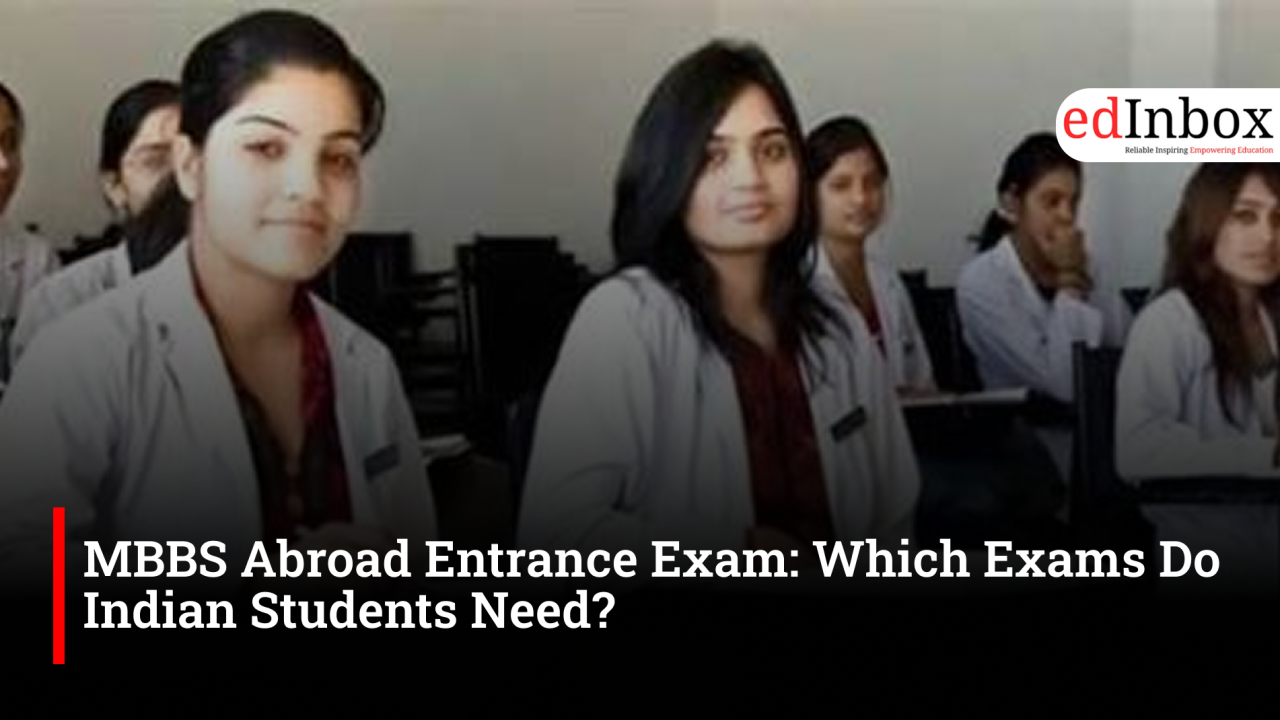
It is a long woven dream to be a doctor and explore the world. MBBS Study abroad offers both together. But what is the MBBS abroad entrance exam for Indian students? There is no single entrance test accepted by every foreign medical university. For Indian citizens and eligible OCI candidates seeking an undergraduate medical qualification abroad, NEET-UG is a key requirement under the applicable NMC framework, while an additional admission test may be required depending on the country, university and programme. Students should therefore check both the latest NMC requirements and the official admission rules of their chosen university before applying.
The most important point for students searching for MBBS abroad for Indian students is that entrance requirements differ by destination. NEET-UG is relevant to Indian students under the NMC framework, while tests such as UCAT, UCAT ANZ and IMAT apply only to specific universities or medical programmes.
|
Entrance exam |
Full Form |
Where it may apply |
Key information |
|
NEET-UG |
National Eligibility cum Entrance Test (Undergraduate) |
Indian students seeking medical education abroad |
Qualification is required under applicable NMC requirements |
|
UCAT |
University Clinical Aptitude Test |
Participating UK and selected international medical schools |
Requirement depends on the university and course |
|
UCAT ANZ |
University Clinical Aptitude Test for Australia and New Zealand |
Participating universities in Australia and New Zealand |
Required for relevant courses at participating institutions |
|
IMAT |
International Medical Admissions Test |
Certain English-taught Medicine and Surgery programmes in Italy |
Admission test requirement depends on the applicable programme and admission cycle |
|
University-specific tests |
Selected foreign universities |
Requirements vary by institution |
The UCAT is taken into account by UK medical schools that take part, plus some overseas universities. The UCAT Consortium site names certain international institutions for the 2027 entry cycle, including Nanyang Technological University, National University of Singapore, and Thammasat University.
In Australia and New Zealand, UCAT ANZ is used as an entry requirement at universities that are part of the consortium. It also applies to relevant courses. The official page lists medical options at Monash University, UNSW, the University of Auckland, and the University of Otago.
That said, UCAT ANZ is not needed for every medical route. Some pathways have different rules. So each applicant should read the requirement for the exact course they want.
If you are an Indian student and you plan to study medicine abroad, NEET should be part of your early planning. Under the NMC rules, Indian citizens and eligible OCI holders who want a main medical qualification abroad must follow the NEET rule that applies to them. Check the latest requirements for your category and your admission year. Do not depend on older guidance.
Also, passing NEET does not automatically mean that every foreign school will use NEET for its own entry process. Some universities may run their own academic checks or entrance exams. They may still have extra admission rules beyond what Indian regulations require for you.
The MBBS abroad eligibility depends on the university and country, but Indian students must pay particular attention to the NMC requirements if they intend to return to India and seek medical registration. The NMC's Foreign Medical Graduate Licentiate (FMGL) framework sets requirements for foreign medical education, including the duration of the course, medium of instruction, curriculum, clinical training and internship arrangements.
The NMC's current guidance specifies, among other requirements, a minimum 54 months of education in a single institution, a 12-month internship at the same foreign university, English as the medium of instruction and clinical training that is not split across different countries. Students should verify the latest applicable regulations before choosing a university.
Students planning to practise medicine in India after completing their foreign medical degree should also check the applicable NMC requirements for foreign medical graduates, including the requirements for registration and any licensing examination that may apply. The NMC has advised students to verify course duration, curriculum, clinical training and internship arrangements before taking admission, as non-compliance can affect eligibility for registration in India.
The MBBS abroad admission process begins with choosing a country and university and checking its current eligibility and entrance requirements. Depending on the destination, students may need an admission test, academic qualifications, language proficiency or an interview. For example, Italy's official Universitaly portal states that admission requirements can vary by programme and may include previous qualifications, grades, an admission test or interview and language requirements. Its official information also identifies Medicine and Surgery as a single-cycle programme and provides information on admission to English-taught medical programmes through IMAT.
After confirming eligibility, students generally need to complete the university application, submit the required documents and follow the institution's admission and enrolment process. International students must also separately meet the applicable visa and immigration requirements of their destination country.
Before paying an application or admission fee, Indian students should check:
The NMC has specifically warned Indian students about foreign medical institutions that do not comply with its prescribed requirements and advised them to conduct due diligence before admission.
If you are seeking to take one entrance exam only to be eligible for most MBBS universities, there is no such single MBBS abroad entrance exam for all international medical universities. For Indian students, NEET-UG is a crucial regulatory requirement, while additional examinations such as UCAT, UCAT ANZ or IMAT may apply depending on the destination and university. The safest approach is to check the latest NMC rules alongside the official admission requirements of the specific medical university before making a decision.

Joomla! core
Joomlart's Co-Founder
UberTheme's CEO