Section 176 of Bharatiya Nagarik Suraksha Sanhita, which amends Code of Criminal Procedure, makes forensic investigation mandatory in crimes carrying imprisonment of 7 years or more.
The Bharatiya Nagarik Suraksha Sanhita (BNSS), the new procedural criminal law mandating forensic investigation of certain offences, would put "immense stress" on laboratories, the Calcutta High Court stated last week. It directed the Union government to designate a laboratory at Kolkata as a central forensic science laboratory (CFSL) to help meet the requirements.
This [amendment] would bring unprecedented pressure on the already established central forensic laboratories and state forensic laboratories to analyze forensic samples, including blood and other fluids, for DNA testing, obtained from the occurrence site," the court stated.
The court then directed the Centre-owned Union government to declare Calcutta's National Institute of Biomedical Genetics (NIBMG), entirely owned by the Centre, as a "CFSL laboratory", to which the NIMBG scientists would be accredited "government scientific experts" status according to law, making them eligible as witnesses before courts.
The BNSS, replacing the previous Code of Criminal Procedure, has been brought in to "use technology and forensic sciences" and "reform" the criminal justice system.
To be specific, Section 176 of the BNSS, providing the procedural guidelines for criminal investigations, has added a provision, to be implemented within five years, mandating forensic evidence in some offences.
Here's ThePrint explaining the provision and when and how it will be implemented.
The provisions of the Act
Section 176 of the BNSS prescribes the overall procedure that investigation agencies are to follow after a crime, and the way a police officer comes to know about a crime and acts.
Sub-section 3 mandates the forensic authorities to collect forensic evidence from the crime scene for every offence which carries more than seven years of punishment. The forensic authorities will visit the crime scene after the police have gained information regarding the crime and collect the forensic samples, which would further be used by the police in order to conduct their investigation.
Where receipt of information is concerning the commission of an offence punishable with a term of imprisonment for seven years or more, the officer commanding a police station shall…order the forensics expert to proceed to the scene of crime to collect forensic evidence in the offence as well as for video recording of the process on a mobile phone or any other digital device, Section 176 (3) of the BNSS provides.
This sub-section will be in force and effective only after the concerned state government notifies a date for the commencement of the section. Once the date is notified by the state government, it must do so in the gazette and upon such notification, the section will commence and its provision will be enforceable.
The Act remains mute on the implication of state governments that do not notify a date for the coming into force of the section. After the states have taken action, in each offence for which an imprisonment of more than seven years is provided, it will be mandatory to conduct a forensic analysis of the crime scene on a direction by a police station in-charge.
Offences such as rape, child trafficking, murder, and dowry death, all of which draw sentences of more than seven years, fall under the purview of the additional requirement of collecting forensic evidence from the site of the crime.
If a state does not have a forensic laboratory to conduct such tests, the clause in the law allows a forensic testing centre located in another state to conduct them.
The erstwhile replaced criminal law system lacked fixed legal requirements for gathering forensic evidence from crime scenes. It depended on the state police whether or not there was a requirement for this kind of evidence.
There have been several concerns raised through the law, including the extensive coverage of forensic data collection including private individuals, the enhanced coverage of personal data collection, and exemptions restraining judicial oversight in forensic reports.
To meet the infrastructural demands brought by the new law, the Centre has set up the National Forensic Science University for enhancing the number of graduating forensic science personnel and scientists every year.
Such laboratories as the Central Forensic Sciences Laboratories (CFSL) in Delhi are similarly gearing up, training and special workshops to prepare their personnel, in the wake of the massive resources and infrastructure required for the successful deployment of the new law at scale.
Nagpur led India's civil engineering fraternity in hosting the National Seminar on Forensic Civil Engineering on 10–11 October 2025, which was instituted by the Institution of Engineers (India), Nagpur Local Centre. The seminar was attended by over 400 delegates comprising civil engineers, researchers, consultants, and academicians from across India for the single-minded purpose of looking for ways to advance structural safety and sustainability.
Under the heading "Understanding, Diagnosing, and Preventing Failures in Structures," the seminar looked at the ways in which forensic science can be employed to prevent and investigate catastrophes within bridges, roads, and other large infrastructures. Some of the topics covered included structural forensics, material degradation, geotechnical failure, environmental forensics, transportation infrastructure, water infrastructure, even legal and ethical principles that guide such investigations.
Some of the seminar attractions included the showcase of 20 real case studies with structural collapse and the techniques of inquiry that were used to lead them to resolution. The examples were best to highlight means by which forensic engineering would make India's transition towards developing and sustaining infrastructure stronger.
Parallel to this was an exhibition featuring the latest diagnostic equipment, test equipment, and materials used in failure analysis, with special focus on technology used in current engineering work.
The seminar was opened by Union Minister Nitin Gadkari, who was the guest of honor and was conferred the Honorary Fellowship of the Institution of Engineers (India) — an award given to only 52 high-profile personalities in 105 years of the institution. The award recognized Gadkari for his contributions towards sustainable infrastructure and public work innovation.
In hosting this historic seminar successfully, Nagpur reaffirmed itself as a rising hub of forensic civil engineering in India, leading the way with a model for infrastructure development in the country of safety culture, transparency, and innovation.
Noted speakers such as Dr. C.V.R. Murthy (IIT Madras), Dr. Pradeep Ramancharla (CBRI Roorkee), and Prof. Abhay Bambole (VJTI Mumbai) shared authoritative opinions on structural integrity and technological advancements.
Thirteen Indian forensic medicine experts and researchers were included in Stanford University's Top 2% Scientists list for 2025, a source of great pride for India's scientific and medical community. This global recognition says a lot about their superior quality research work, clinical acumen, and contribution to developing the science of forensic medicine.
The ranking, published every year by Stanford University, orders researchers globally by career-span citation influence, h-index, and co-authorship-adjusted measures—parameters that consider both the amount as well as the quality of published work. Indian experts being included show the nation's increasing contribution to global forensic research and innovation.
Saluting India's Forensic Pioneers
They are also accompanied by Dr. Shankar M. Bakkannavar, Dr. Ashith Acharya, who has also been included on the list for five years in a row, Dr. Tahir UL Gani Mir, and Dr. Sweety Sharma.
Their identification not only speaks volumes of individual merit but also proves to be an indicator of India's growing education and research platform in forensic sciences. These specialists have made immense contributions to areas such as forensic pathology, toxicology, medico-legal examination, and forensic odontology, which have made the country's medico-legal framework even stronger.
Global Impact and Future Outlook
As India continues to invest in forensic research and education, these success stories motivate the next generation of scientists to excel in research. Acknowledgment of these thirteen professionals is the proof of India's new dominance in the area of forensic medicine and its contribution to world health and justice.
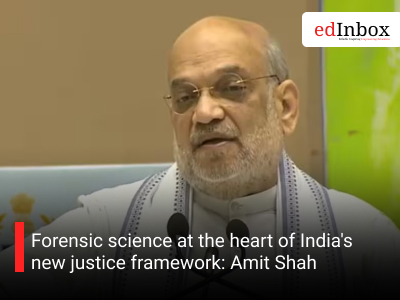
Union Home Minister and Cooperation Minister Amit Shah on Monday underscored the revolutionary role forensic science would serve in India's revamped criminal justice system.
Addressing the All India Forensic Science Summit 2025 in New Delhi, organized by the National Forensic Sciences University (NFSU), Shah expressed gratitude to Prime Minister Narendra Modi for transforming the justice system in India with a focus on scientific and technology-based investigations. He went on to add that contemporary crimes are likely to go beyond borders, as is enabled with advances in communications and information technologies, so strong forensic capability is more than ever essential.
The home minister emphasized that these laws replace colonial codes, which are antiquated, and bring in contemporary tools like e-documents, digital summons, and forensic evidence into the legal system. Forensic analysis is now being made compulsory for offenses punishable by over seven years in prison—a very important step towards enhancing the existing conviction rate at 54 percent.
Shah referred to recent instances wherein trials of rape and murder cases were concluded and convictions were obtained within weeks. He emphasized the police's digitization of infrastructure: 100% of police stations are networked with Crime and Criminal Tracking Network and Systems (CCTNS) now, with over 14 crore First Information Reports (FIRs) and connected information online. These types of systems such as electronic Forensics (e-Forensics), National Automated Fingerprint Identification System (NAFIS), and electronic Prison Management System (e-Prison) are constructing a humongous national database, which will shortly be augmented by Artificial Intelligence (AI) for predictive policing and crime prevention.
Seven campuses are already functioning, nine more are opening shortly and ten more will be set up, which will give it a pan-India presence, claimed the home minister.
All the campuses would focus on a specific niche—like drone, marine, or corporate forensics—and the university would be producing about 36,000 forensic professionals every year, he said.
The home minister promoted the creation of a more humanized judiciary and suggested psychological counseling and criminal classification according to the nature and intent of the offense. A prisoner rehabilitation system with a forensic-oriented perspective would be established in the upcoming two years, he stated.
Shah also discussed the creation of the Modus Operandi Bureau, which would have a study on criminal behavior to further the crime prevention strategy. He demanded greater coordination between NFSU and the Ministry of Home Affairs, and praised young entrepreneurs for their performance during the hackathon of the summit and for popularizing the application of Hindi in forensic science.
Shah again emphasized that India is firmly on a mission to create a crime-free, fair, and technologically advanced society.