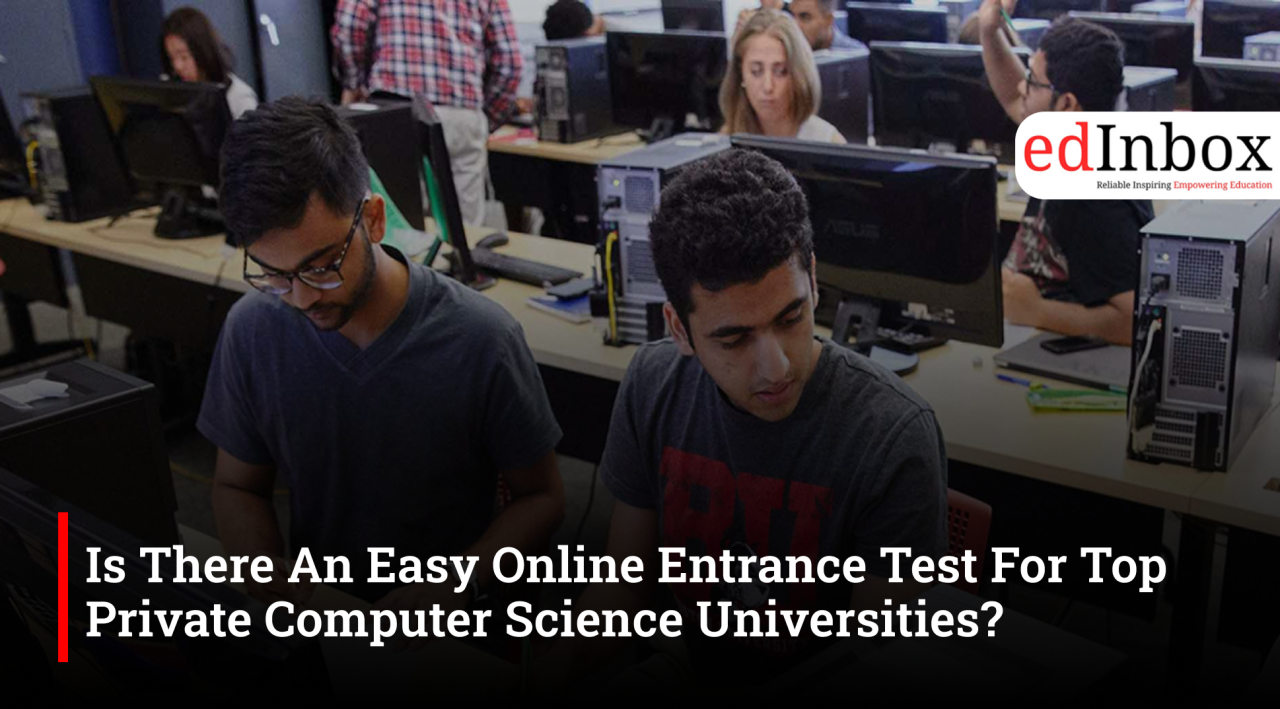
If you are planning to pursue computer science after Class 12, choosing the right entrance exam can be an important part of your admission plan. There are some universities with their own tests, and others with more general national-level tests. This leaves many students wondering, is there an easy online entrance exam for computer science that can help me apply to private universities?

One option students can consider is the Global Computer Science Entrance Test (GCSET). It is a national level entrance exam for computer science and technology courses and courses are listed for both undergraduate and postgraduate courses, such as BCA, B.Tech, B.Sc IT, M.Tech, M.Sc and MCA. 

However, the term easy is not a good description of any entrance exam. One way to assess whether an entrance exam is suitable is to look at who is eligible to take the exam, the structure of the exam, the time allowed, how the exam is marked, and, most importantly, which universities and programmes accept the score.

What is GCSET?

Global Computer Science Entrance Test (GCSET) is a national-level online entrance test created for students who seek admission in computer science and technology courses in top private universities in India.

GCSET is designed in an ideal way to test the skills and potential of a student who wishes to pursue computer science and technology. It lists programmes at both undergraduate and postgraduate levels, including BCA, B.Tech, B.Sc IT, M.Tech, M.Sc and MCA. This gives students interested in computer science and related fields an entrance route covering different stages of higher education. GCSET official website. The undergraduate eligibility route is especially relevant for a Class 12 student. Students do not need to complete graduation before applying for the UG examination.

Is GCSET an online entrance exam?

Yes, GCSET 2026 is an online exam which can be taken by the candidates on their mobile, laptop or desktop, as per the guidelines provided by GCSET. There are 100 multiple choice questions to be answered in 60 minutes. One mark is awarded for each correct answer and there is no penalty for an incorrect answer.

This makes the structure relatively simple. The real challenge is time; candidates are given an average of less than a minute per question, so it is not enough to know the subject matter to prepare. The speed and the choice of questions are also important.

The examination guidelines also include that candidates are required to log in at least 15 minutes prior to the examination and that the online test will be monitored by cameras, sound and browser activity. GCSET exam guidelines

After class 12, who can apply for GCSET?

As per the current eligibility criteria of UG, the candidate should have completed 10+2 or equivalent with Physics, Chemistry, Mathematics and/or Computer Science as core subjects and should have obtained 50% aggregate marks.

Students who are appearing for their class 12 exams can also apply. The present criteria enable the candidate to take the GCSET exam up to three times. The requirements are for the current admission cycle and students applying in a future year should refer to the eligibility criteria for that year.

What courses are offered in GCSET?

GCSET is not limited to one undergraduate degree. It has official information that includes a variety of computer science and technology programmes. At undergraduate level, the listed programmes include B.Tech, BCA and B.Sc IT. At postgraduate level, the options include M.Tech, M.Sc and MCA.

This is important when comparing entrance exams. A student looking for a B.Tech admission path is different from someone who wants to do an MCA after graduation. Always check the relevant course, eligibility and participating institution before applying.

Why do students look for an easy online computer science entrance exam?

Because what is easy for one student may be challenging for another, depending on their academic background and preparation. However, when students are looking for an easy computer science entrance exam, they typically want a few things: an online exam, a clear question pattern, a reasonable time limit, and no penalty for incorrect answers.

Some of these features are incorporated into the current format of GCSET. The test is online, has 100 MCQs, is 60 minutes long and has no negative marking. It can be helpful to not have negative marking, but it should not be used as an excuse to prepare less. The exam is still a test of knowledge and aptitude and the time constraint makes preparation important.

How to apply for GCSET?

Passing the entrance exam does not guarantee admission. The ongoing GCSET process is generally: Registration, Examination, Result, Counselling and Admission. 

Candidates will be able to check their result and scorecard on the candidate portal after the examination. The counselling process is then followed by the selection of a preferred campus, provisional admission and seat booking.

This is a significant difference for students studying private university entrance exams. An entrance score is a part of the admission process; it should not automatically be read as a guarantee of admission to every institution or programme. Students are advised to verify the eligibility of the course, the participating university, seat availability and admission requirements before finalizing their decision.

Is GCSET easier than other computer science entrance exams?

There is no universal answer. The difficulty of an entrance examination depends on the candidate, the syllabus and the level of preparation. Some students may find the current GCSET format manageable because it is conducted online and has no negative marking, but those features alone do not determine the difficulty of the question paper.

For example, the current GCSET B.Tech syllabus includes Mathematics, Physics, Chemistry, Computer Fundamentals, English Language, Logical Ability and Reasoning, and General Awareness. Therefore, instead of asking only, “Which computer science entrance exam is easiest?”, students should ask: “Which entrance exam is accepted for the course and institution I want to join?”

That approach is more useful because an entrance exam is only valuable if it leads to the academic option a student actually wants.

What should students check before choosing a computer science entrance exam?

  • Eligibility: Confirm that your Class 12 subjects , and your marks , actually match the requirement.  
  • Exam pattern: Check how many questions are there, how much time you get , and whether there is negative marking  
  • Programme: See if the exam actually gives you an admission route for the B.Tech, BCA or B.Sc IT programme you want  
  • Institution: Find out which participating university or institution accepts the score, and also what extra admission condition is required  

For students considering GCSET, these points feel extra important, because the test is only one piece in the larger admission process, not the whole story.

In the end, GCSET is for all the B.Tech aspirants in India who wish to pursue computer science. It is a 100% online entrance test that opens doors to top universities in India. An “easy” entrance exam is not always the best entrance exam. The better option is usually the one where your eligibility, exam format and admission path fit both the course and the institution you plan to study at.

From recommendation systems and fraud detection to chatbots and predictive tools, artificial intelligence may be making the headlines, but behind these technologies are people who build, train and deploy them. They are called Machine Learning Engineers. This is one of the most sought-after roles in the AI/ML ecosystem, and people are making lakhs with top-notch skills and problem-solving AI models, both in India and abroad.

If you are looking for how to become a Machine Learning Engineer in India, you do not merely need to focus on mastering AI; it requires mastery in programming, maths, statistics, data skills, machine learning concepts and project experience.

What does a Machine Learning Engineer do?

A Machine Learning Engineer designs systems that enable computers to learn from data and make predictions or decisions. They can be involved in data preparation, model development and testing, optimization, and deployment in real-world applications.

They typically collaborate with data scientists, software engineers and product teams to bring experimental machine learning models to life and into a viable technology that can be adopted by businesses and consumers.

How to become a Machine Learning Engineer in India?

The short answer is, you need to be either a prodigy, highly skilled individual, or something with brimming passion to make a career in this field. The path to becoming a Machine Learning Engineer is not a single one though. But with a solid background in computer science, math and programming, the trip can be a lot easier.

Undergraduate courses like BTech Computer Science, BTech in AI and Machine Learning, BSc Computer Science, BSc IT, and BCA can be beneficial for students after Class 12. Computer science, engineering, mathematics and related disciplines are listed as relevant educational backgrounds for AI careers by the Directorate General of Employment. Students can then specialise in their electives, internships, projects, post graduate education, or specific training in AI and ML.

What skills does a Machine Learning Engineer need?

Python is one of the most popular programming languages for machine learning. Students should also acquire knowledge of SQL, data structures, statistics and data handling. The next step is to learn the core concepts of machine learning like regression, classification, clustering, model evaluation and overfitting. Students can then explore deep learning, neural networks, computer vision, natural language processing and generative AI.

The position is also becoming more and more hands-on. Students can gain insight into how models can be taken from experimentation to real applications by learning about APIs, cloud platforms, deployment, monitoring, Docker and MLOps.

What to Study after class 12th?

Selecting the right undergraduate program is a crucial initial choice for students who want to pursue a career in machine learning. A good course should have more than an AI related title. Students should look at the curriculum, subjects covered in the programming, mathematics, labs, project work, internships and industry exposure.

This is also why it is crucial to select the right computer science entrance exam after Class 12. Students can make comparisons between various admission methods before deciding on the university and programme that is most suited to their long-term goals.

The Global Computer Science Entrance Test (GCSET) is another computer science entrance exam option for those interested in pursuing computer science studies. As per information given by GCSET, it provides admission to courses like BCA, BTech, BSc IT, MCA, MTech and MSc. The exam is done online, followed by results, counselling and the admission process.

Is it necessary to have a degree to be a Machine Learning Engineer?

While a relevant degree can give you the academic background, it's not enough to make someone a Machine Learning Engineer. It is important to have practical skills. Students should develop projects that demonstrate how they have collected and cleaned data, trained models, evaluated results, and (if feasible) deployed a working solution. These skills can also be showcased through a solid portfolio when applying for internships and entry-level positions.

What is the salary of a Machine Learning Engineer in India?

Machine Learning Engineer salary in India is dependent on their experience, technical skills, location, employer, and job role. Machine Learning Engineer, Data Engineer and Research Scientist positions in the machine learning sector have an indicative average salary range of ₹6 lakh to ₹18 lakh or higher, according to the Directorate General of Employment. This is not a guaranteed starting salary. The salary of freshers can vary significantly based on their skills, internships, projects, and employer.

What are the career prospects of Machine Learning Engineering?

Machine learning is related to a number of emerging fields such as artificial intelligence, data science, computer vision, natural language processing, recommendation systems, robotics and generative AI. The Directorate General of Employment, Government of India also mentions the significance of programming, machine learning algorithms, data mining and statistical analysis in the field of ML.

The overall AI talent landscape is growing as well. As per NASSCOM's estimate, India's AI talent pool will expand from approximately 6–6.5 lakh professionals to over 12.5 lakh by 2027.

Machine Learning Engineer roadmap after Class 12

If you are a student who is just beginning, the Machine Learning Engineer roadmap might look something like this:

Class 12 → Computer Science/related degree → Python + Mathematics → Data Structures + SQL → Machine Learning → Deep Learning → Projects → Internships → Model Deployment → Machine Learning Engineer 

The key is that this is a skills-based journey. It helps to take courses, but it's important to be able to solve problems with data and create working systems.

Is Machine Learning a good career in India?

Machine learning is a potential career path for students who are interested in coding, math, problem-solving and technology. It's not a quick route to a technology career, though. The field has a rapid pace of change and professionals need to keep learning beyond the degree. The ideal moment to begin is thus not when a student is already familiar with all there is to know about AI. It is when they are ready to learn the basics, try out projects in reality and lay the groundwork for the next generation of technology.

If you ask a class 12 student today what he wants to study, then probably Computer Science will be in the top three. Artificial Intelligence, cybersecurity, cloud computing, software development and data science are impacting every industry and students are wanting to be in these fields. Meanwhile, there has been growing doubt among students on the usefulness of traditional entrance exams, and whether they really gauge one's ability or just this year's yearbook.

Part of the reason is the shift in thinking, which is why the Global Computer Science Entrance Test (GCSET) is gaining momentum without even being a household name yet.

GCSET has been designed with a different approach than many traditional entrance exams, which are usually speed, pressure and elimination tests. GCSET aims to discover students who possess the aptitude, logical thinking and fundamental knowledge for success in the field of computer science.

Today's Students Want Fair Exams, Not Impossible Ones

GenZ is the generation that has been brought up in the world of technology; they take in information via YouTube, coding sites, online communities, AI and hands-on projects. A lot of people have even created websites, learned about Python, developed apps, or even tried to make games before they even decided to go to college.

Students are not asking the riddle questions to shorten the number of qualifiers, but rather are asking questions that truly test the understanding. GCSET adopts this approach, emphasizing on the following:

  • Logical reasoning
  • Analytical thinking
  • Computer science aptitude
  • Problem-solving ability
  • Academic fundamentals

The goal is simple: to find students who are truly ready to take up computer science, no more, no less.

Right Exam is Never About the Difficulty

A common complaint made by students about competitive exams is that many questions appear to be "culling" students rather than assessing them. This sometimes makes the truly skilled ones lose their chance, while the memorisation experts make their way forward. If the test is too hard, there is a high chance that you will need to take it many times, and to be coached and worked hard, to be successful.

GCSET entrance test is more of a student-centered approach because this is a fully-remote exam of 60 minutes in duration, designed to measure a candidate's aptitude and knowledge in a balanced way. Rather than testing the candidates with unnecessarily difficult questions, the emphasis is to determine candidates with appropriate skills to be able to work successfully in technology programmes. Students see this as a chance to show off their abilities, instead of going through an elimination process.

The Growth of Computer Science is Faster than Most Careers

The popularity of computer science isn't driven by trends alone. Artificial intelligence, cybersecurity, cloud computing, software engineering and data analytics are transforming industries including healthcare, finance, education, manufacturing, agriculture and government services.

The technology sector continues to witness remarkable growth:

  • Around 1.5 million technology job openings are projected by 2026
  • Technology job postings continue to increase year after year
  • India is expected to have over 1.2 million technology jobs
  • The global technology ecosystem continues expanding rapidly

This growing demand means students are no longer looking only at traditional engineering pathways. Programmes like BCA, B.Sc IT, MCA and specialised computer science degrees are becoming equally attractive because they open doors to emerging technology careers. 

Courses to Pursue after Computer Science Entrance Test

Many students think that computer science is just a B.Tech degree. In reality, today's techno-ecosystem has several academic tracks. Students can use GCSET score to pursue courses such as:

  • BCA
  • B.Tech
  • B.Sc 
  • MCA
  • M.Sc
  • M.Tech

This flexibility enables students to select programmes which suit their interests, academic background and future career aspirations.

Designed to Test Skills and Basic Knowledge

Employers are looking for employees who have the ability to problem solve and are fast learners and adaptable to new technology. Technical skills are still relevant, but companies also seek analytical thinking, logical reasoning and an understanding of new concepts. These are the skills GCSET seeks to measure. The exam is not designed for rote learning, but is more like what students will be expected to do in college and in the workplace.

Simpler Admission Process

Several students are not so enthusiastic about applying to several universities, due to the fact that each university may have different admission processes, admission deadlines and required documentation. 

GCSET makes this easy with a formal admissions process: Registration → Online Examination → Result → Counselling → Admission

The accelerated process allows the students to concentrate on preparing for the future rather than getting caught up in complicated admission procedures.

Why Students Are Beginning to Notice GCSET 

While not yet fully developed, the trend of students' growing interest in GCSET is part of the larger shift in higher education.

Today's applicants want:

  • Ability based entrance tests
  • Transparent admission processes
  • Opportunities in a variety of institutions
  • Career-focused programmes
  • Skills that will continue to be useful in an AI world.

Rather than making examinations difficult for the sake of difficulty sake, GCSET is oriented towards selecting those students who have the aptitude to succeed in computer science and technology. That's a difference that's very loud to a generation that cares about fairness, practicality and real world learning.

Note for Computer Science Entrance Exam Aspirants

Students who don't wait till the last minute to make life-changing decisions are likely to reap the rewards in terms of fewer people competing for opportunities, more options for admission, and exams that are more reflective of contemporary education.

GCSET is more than just a test; it is a gateway for aspiring software developers, cybersecurity professionals, AI engineers, cloud architects, data scientists, and technology innovators to enter the world of cybersecurity. It is a way of thinking that is a measure of what computer science education should really be judged on: curiosity, analysis, problem solving, readiness to learn.

Given the growing prominence of the digital economy in India, such entrance examinations that focus on skills rather than complexity will increasingly gain importance. GCSET is placing itself in that future by providing pupils with an assessment that's not designed to discourage them, but to discover their potential.

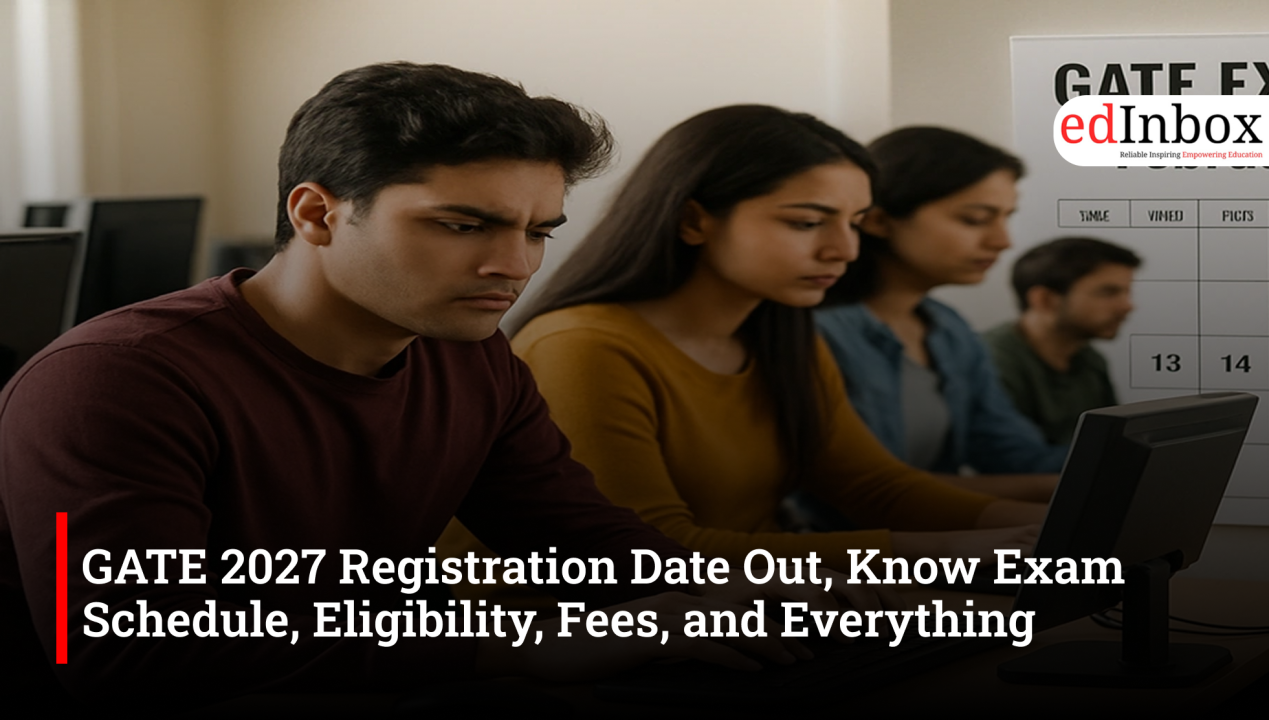
The Graduate Aptitude Test in Engineering (GATE) 2027 registration schedule is out. Conducted for admission to postgraduate technical programmes, GATE is one of India's most important entrance examinations for engineering graduates. This year, IIT Madras has introduced a new Robotics and Automation (RA) paper and revised the syllabus for selected subjects.

If you're planning to take GATE 2027, here's everything you need to know about the registration dates, GATE 2027 syllabus, exam schedule, eligibility criteria, application fees and the latest changes.

GATE 2027 Highlights

Particular

Details

Exam Name

Graduate Aptitude Test in Engineering (GATE) 2027

Organising Institute

IIT Madras

Registration Starts

August 14, 2026

Last Date to Apply

September 21, 2026

Extended Registration

September 30, 2026

Exam Dates

February 6, 7, 13, 14, 20 & 21, 2027

Result Date

March 19, 2027

Official Website

gate2027.iitm.ac.in 

What is GATE 2027?

The Graduate Aptitude Test in Engineering (GATE) is a national level entrance test that assesses the understanding of the student in undergraduate subjects.

GATE scores are required for admission into post-graduate courses like M.Tech, M.E. and Direct PhD from IITs, NITs and IISc. GATE scores are also taken into consideration in the recruitment process at various Public Sector Undertakings (PSUs).

What's New in GATE 2027?

The introduction of the Robotics and Automation (RA) paper is one of the most significant changes that are being introduced in GATE 2027.

IIT Madras has revised the syllabus for selected papers (apart from the new paper). Candidates are requested to refer to the updated Syllabus for their preparation.

GATE 2027 Registration Date

The online registration process for GATE 2027 will start from 14 August 2026. The last date of application is 21st September 2026. Anyone who is late in the deadline will be able to apply until September 30, 2026, with a late fee. If you register in the regular registration period, you will not be charged for additional registration.

GATE 2027 Exam Date

As announced, GATE 2027 will be held on:

  • February 6, 2027
  • February 7, 2027
  • February 13, 2027
  • February 14, 2027
  • February 20, 2027
  • February 21, 2027

There will be two sessions of examination each day:

  • Morning Session: 9:30 am to 12:30 pm
  • Afternoon Session: 2:30 pm to 5:30 pm

GATE 2027 Eligibility Criteria 

Before applying, candidates should make sure they meet the GATE 2027 eligibility criteria. You can apply for GATE 2027 if you:

  • Are currently studying in the third year or above of an undergraduate degree programme.
  • Have already completed a government-recognised degree in Engineering, Technology, Architecture, Science, Commerce, Arts or Humanities.

Candidates who have qualified through professional bodies such as The Institution of Engineers (India), IETE, ICE, AeSI, IIChE, IIM, or IIIE can also apply, provided their qualification is recognised as equivalent to a degree by the Ministry of Education (MoE), AICTE, UGC or UPSC.

Students pursuing or holding a qualifying degree from a recognised institution outside India are also eligible. They must either be in the third year or above of their bachelor's programme or have completed a bachelor's degree of at least three years' duration in Engineering, Technology, Architecture, Science, Commerce, Arts or Humanities.

If you meet any of the above eligibility conditions, you can apply for GATE 2027.

How to Apply for GATE 2027

The candidates have to apply online by visiting the official GATE website according to the following steps:

  • Visit gate2027.iitm.ac.in 
  • Now click on the link to register for GATE 2027.
  • Fill in the application form.
  • Upload necessary documents
  • Complete the application form and pay the application fee.
  • Submit the form.
  • Once submitted, print out the confirmation page for future reference.

GATE 2027 Application Fee

Female, SC, ST and PwD Candidates

  • ₹1,000 per paper (Regular)
  • ₹1500/- per paper (Late Registration)

Other Candidates

  • ₹2,000 per paper (Regular)
  • Late Registration: ₹2,500 per paper

GATE 2027 Important Dates

Event (Tentative)

Date

Registration Begins

August 14, 2026

Registration Closes

September 21, 2026

Extended Registration

September 30, 2026

City Intimation

January 4, 2027

Examination

February 6, 7, 13, 14, 20 & 21, 2027

Result

March 19, 2027

Note: As per the official announcement, the dates can change. It is advised to visit the official portal to stay updated.

GATE 2027 Exam Pattern

Particulars

Details

Mode of Examination

Computer Based Test (CBT)

Language of examination

English

Duration

3 Hours*

Number of papers (Subjects)

30 test papers

Sections

General Aptitude (GA) + Candidate's Selected Subject(s)

Type of Questions

(a) Multiple Choice Question (MCQ)

(b) Multiple Select Question (MSQ)

(c) Numerical Answer Type (NAT)

Testing of abilities

(a) Recall

(b) Comprehension

(c) Application

(d) Analysis & Synthesis

Distribution of Marks in all Papers EXCEPT AR, CY, DA, EY, GE, GG, MA, PH, RA, ST, XH, and XL

  1. General Aptitude: 15 marks
  2. Engineering Mathematics**: 13 marks
  3. Subject Questions: 72 marks
  4. Total: 100 marks
  5. (**XE includes Engineering Mathematics section XE0 of 15 marks)

Distribution of Marks in papers AR, CY, DA, EY, GE, GG, MA, PH, RA, ST, XH, and XL

  1. General Aptitude: 15 marks
  2. Subject Questions: 85 marks
  3. Total: 100 marks

Marking Scheme

Questions carry either 1 mark or 2 marks

Negative Marking

Yes

  • For a 1-mark MCQ, 1/3 mark deducted for a wrong answer.
  • For a 2-mark MCQ, 2/3 mark deducted for a wrong answer.
  • No negative marking for wrong answer(s) to MSQ or NAT questions.
  • No partial marking in MSQ.

Why are Students Applying to the GATE?

Students take GATE Entrance test because a good score may lead to:

  • M.Tech admissions
  • M.E. programmes
  • Direct PhD admissions
  • Recruitment at PSU (as appropriate)

GATE being an important exam for students aiming at higher education or any government career is crucial.

Is it too early to begin preparing for GATE 2027?

The registration process will start in August and the exam is to be held from February 2027, providing candidates with ample time to prepare. However, more months for preparation doesn’t entail one will pass the exam. Until the aspirant dedicated study, learn time management, and ensure to be prepared weeks before the exam, clearing GATE would be difficult.

GATE 2027 aspirants must first read the latest syllabus, particularly for the revised subjects and know the exam schedule before they begin the preparations for the subjects. It is also advised to start the preparation early for higher chances of a good score. 

Is GATE 2027 Worth the Efforts?

GATE 2027 introduces several significant changes, such as the introduction of the Robotics and Automation (RA) paper and updated syllabus for certain subjects. Candidates who wish to take up post-graduate studies should keep a check on the registration time frame and start preparation early to make the best use of time and make their efforts worth it.

However, if you are someone who is taking GATE Entrance Test out of influence of other or aren’t sure what to do next or you are considering going for an M.Tech in Computer Science but not sure if GATE is the best path for your career, a conversation with an expert counsellor can help. 

There are entrance tests like GCSET (Global Computer Science Entrance Test) that helps you get into the top university that aligns with your future goals. Before making a decision, you can get free, impartial advice about various ways to get admitted, compare your options, and select the one that is best for your academic plans. Call now @ 9124572780 for free career consultation, and stay informed about the latest updates via GATE 2027 Official Site.


FAQS

When will GATE 2027 registration begin?

GATE 2027 registration process will start from 14 August 2026.

What is the last date to apply for GATE 2027?

The last date for submitting applications is 21st September 2026 (without late fee). The extended registration will be open until September 30, 2026.

What are the changes in GATE 2027?

GATE 2027 has added a new paper on Robotics and Automation (RA). The syllabus of some subjects has also been changed at IIT Madras.

Who can appear in GATE 2027?

According to the announced criteria, students in the third year or more of an undergraduate programme and graduates from recognised institutions are eligible.

What is the expected date of GATE 2027 result?

The GATE 2027 result is expected to be released on March 19, 2027.