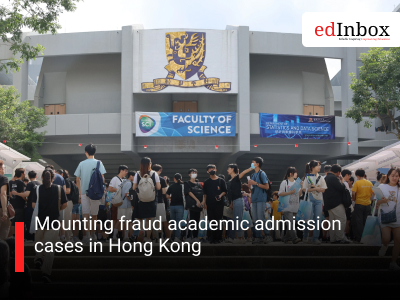
The allegations of admissions fraud continue to spread more widely in Hong Kong, where the city's police this week disclosed that 126 reports of allegedly fraudulent academic qualifications from the city's universities had been received in the first seven months of this year.
But these figures represent just the tip of an iceberg since many cases are not reported to the police by universities, raising concerns that any acceleration in cases could hurt Hong Kong's reputation as a higher education hub.
“ HKU has so far received a few hundred cases this year involving applicants suspected of submitting false academic credentials for admission, a spokesperson from HKU said on 13 October, while adding “none of these cases has been enrolled.
The cases in question principally involved applications to the city's universities by students from mainland China, which have grown in the past 2 to 3 years.
More than 30 students from mainland China were found to try to use fake documents to enroll in HKU's business school last year, even though the institution played it down at first. Then dozens of such cases started coming up one after another.
In May, a student from the mainland Li Sixuan was given an eight-month prison sentence in Hong Kong after she pleaded guilty to faking her Ivy League qualifications in order to apply to HKU for a master's in applied linguistics. She had falsely claimed that she graduated from Columbia University.
Her defence lawyer told the Hong Kong court that his client was “very determined” to study at HKU.
The Chinese University of Hong Kong has announced that it refused "several hundred" applications with suspected fake credentials during the application period this year, most of them from applicants from mainland China.
CUHK's director of admissions and financial aid, Andy Wong, had said, in remarks on 11 October, that their university did not lodge police reports "since the applicants were outside of the city and there is no evidence that the applicants had accomplices in Hong Kong - there is not much they can do".
It was nonetheless a sharp increase from about 10 cases at CUHK the previous year, academics noted, pointing to an escalating problem with exaggerated admissions statements, falsified references and fake credentials.
The Hong Kong Polytechnic University said it had found about 10 cases of fraudulent applications, and the respective applications and admission offers have been canceled.
The police said that, following reports of fraudulent academic qualifications, 55 had been arrested between January 2022 and July this year, with nine so far charged and six convicted. Others were still under investigation.
Hong Kong police also said 21 suspected "unlawful intermediaries", or agents, in mainland China, had been referred to mainland authorities.
More than half of the arrests were made during the first half of this year.
Fear of reputational impact
"Hong Kong is seriously concerned about the implications of such fraud for the reputation of its highly reputed universities. It has much to lose, having vigorously promoted Hong Kong internationally as a higher education hub," a CUHK academic, who wished to remain anonymous, told University World News in an interview.
"There has been a big rush of applications from the mainland because of Hong Kong universities' good results in global university rankings. But the downside is many want to get a Hong Kong degree by hook or by crook. And some are assisted by unscrupulous agents in China."
In January and earlier this month, the ICAC, an independent Commission Against Corruption, in Hong Kong conducted anti-fraud workshops for 40 admissions officers and other staff at universities. Cheuk Chi-yan, head of the Corruption Prevention Department at the ICAC, said in early October that the participants were all managers of the admissions procedures.
They are not only implementers of the system but also guardians of educational values, he said while addressing the workshop.
Hong Kong's undersecretary for education, Shi Junhui, said in the same workshop that with the plan for Hong Kong to turn into a higher education hub "the authorities attach great importance to safeguarding the integrity, quality and reputation of Hong Kong's post-secondary education sector".
He called on the institutions "to work together to safeguard the reputation of higher education in Hong Kong, establish an effective anti-corruption mechanism, uphold the principles of fairness and justice, and work together to create clean campuses".
A Hong Kong Education Bureau spokesperson said on 9 October that with the release of the World University Rankings 2026 announced by Times Higher Education, the publicly funded universities "have continued to hold top spots, rendering Hong Kong the only city in the world with five universities ranked among the global top 100, with all its ranked institutions gaining higher positions".
In the latest THE World University Rankings, released this month, HKU rose two places to 33rd globally, while the CUHK moved up three places to 41st, and the Hong Kong University of Science and Technology jumped eight places to 58th.
"Mainland families are highly rankings-orientated when choosing a university, and these results make an impact. Many more families are turning to Hong Kong, especially with visa problems in Australia and Canada and uncertainty over visas for Chinese students wanting to study in the United States ," said the CUHK academic.
Hardline stance
HKU is one such institution adopting this tough stance. This week, the HKU spokesperson said: “HKU consistently treats cases involving fraudulent documents with the utmost seriousness, adopting rigorous measures during the admissions process.
"Applications suspected of containing fabricated qualifications will not be considered. Applicants who are discovered to have falsified academic credentials will be subject to action by the University." The spokesperson added: "Where concrete evidence of fraudulent misrepresentation is established, we will invariably report the matter to the police for further investigation and prosecution." The Hong Kong government raised its cap on the number of non-local students at undergraduate level in publicly funded universities last year. More than 90 per cent of non-local places have been taken up by mainland Chinese students.
"Following the Government's doubling of the enrolment ceilings for non-local students of UGC-funded universities from 20% to 40% from the 2024 to 2025 academic year, the number of non-local students enrolled in the UGC-funded programmes has recorded double-digit year-on-year growth," the education bureau spokesperson said. Starting from the 2026 and 2027 academic years, the Hong Kong government will raise the enrolment ceiling for self-financing non-local students for taught programmes from around 40% of local student places to 50% the city's Chief Executive John Lee said in his 17 September policy address.
Universities fear even more fraud with the number of non-local students set to rise even further as students from mainland China flock to Hong Kong's highly regarded universities. AI-powered verification A HKPolyU representative said at the ICAC workshop earlier this month that it had a stringent qualification and other document verification process, which included interviews and credential checks, for applicants. HKPolyU now plans to include AI technology in its application process for better academic verification. HKU's assistant director of admissions, Raymond Wong, stated that the AI-assisted interview system adopted by his institution would check students' identity and anomalies during the interviews, thus helping it block impersonation and cheating.