
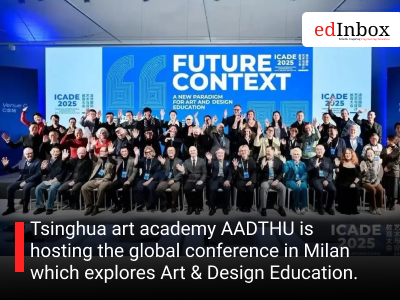
Academy of Arts & Design, Tsinghua University organized an important academic conference with the theme "Future Context: A New Paradigm for Art and Design Education," which took place in Milan, Italy from Nov 15-16.
Organised by the AADTHU, Tsinghua University Milan Institute of Art & Design, and the China-Italy Design Innovation Hub, Tsinghua University hosted the Tsinghua International Conference on Art & Design Education, ICADE.
Present at the event were more than 100 university leaders, professors, scholars, and representatives of industries in China, Italy, Australia, Austria, Belgium, Singapore, the UK, the US, and other countries.
The Suzhou two-day conference included, among other events, eight keynote speeches, two roundtable discussions with university leaders, four thematic forums, two parallel seminars, and a series of international art and design workshops. The program allowed participants to share experiences through cross-disciplinary and cross-cultural dialogues and investigate how artificial intelligence is reshaping artistic expression and educational paradigms.
Opening the conference, Qin Chuan, secretary of the CPC Tsinghua Academy of Arts & Design committee, said the five years since the conference started coincided with dramatic global changes, including revolutionary breakthroughs in AI.
"On such an international platform, we firmly believe that no matter how the global landscape and emerging technologies may evolve, we are staunch companions in art and design education, always committed to increasing communication and deepening cooperation -this is our shared dream," he said. "We are also deeply conscious that art and design are an international language, able even to bind the world together in these uncertain times."
He pointed out that ICADE focuses on building a collaborative platform for the future this year, including deep integration in technology and culture. The topics he noticed included redefining creative logic in the AI era, restructuring educational systems in an interdisciplinary context, finding the possibility of symbiotic coexistence in the face of cultural diversity.
We are very much looking forward to collaborating with all the participants at this conference, jointly envisioning the future of art and design education in order to establish a framework for cooperation that could be continuously developed while facing the world and embracing tomorrow.
Other opening-ceremony speakers included Anna Barbara, president of POLI.design, a consortium of Politecnico di Milano; Dalia Gallico, executive vice president of the World Olymp'Arts Council; Lorenzo Imbesi, president of the Cumulus Association; and Wu Jian, head of the Haier Innovation Design Center. Wu Qiong, dean of the Academy of Arts & Design at Tsinghua University, sent a congratulatory letter. Shi Danqing, associate dean of AADTHU, presided at the ceremony.
Design, as a discipline, stands at that critical turning point that technological advancement, imminent social problems, and new business models all push against, together. May this conference serve as a catalyst in sparking in-depth dialogue on reconstructing educational models and integrating art with technology within new contexts, thus inspiring renewal of vitality.
On the first day, keynote speeches and leaders' roundtable took place, gathering together the leaders of world-renowned art and design institutions and pioneering founders of newly established schools that have garnered worldwide attention. The speakers connected classical heritage with future trends and focused on current innovations so as to promote sustainable development of art and design education.
Distinguished speakers included Anna Barbara, president of POLI.design; Rebecca Wright, dean of the S School at Central Saint Martins College of Art; Rachel Dickson, deputy director of the Glasgow School of Art; Francesco Zurlo, dean of the School of Design at Politecnico di Milano; Yang Dongjiang, chair of the academic committee at AADTHU; Kun-Pyo Lee, dean of the School of Design at the Hong Kong Polytechnic University; and John Ochsendorf, founding director of the MIT Morningside Academy for Design. Barbara defined the digital revolution as a "revolution of time" and asked designers to turn their attention to forming time and not only physical space. She added that AI will be applied to serve as a tool for harmonizing human needs with the environment, to help resolve the conflicts of a digital world, and to create a more sustainable shared economy.
According to Wright, design education has to keep optimism in view of uncertainty in the future, and constructing a new "design language" is the key in dealing with challenges. She pointed out, "The real challenge is not whether one must adopt AI, but how to integrate technology with uniquely human wisdom." Dickson said design education needs to break through traditional disciplinary frameworks and promote educational innovation based on cross-field collaboration. She said in the future, design education needs to be grounded in a balance of tradition and innovation, with curiosity at its heart.
She further called for an interdisciplinary system that is more inclusive and capable of solving global challenges, including sustainable development. Francesco Zurlo developed the concept of interdependent design during his talk and stressed that design education has to be able to face complexity and not simplify problems. According to him, contemporary design needs to reunite humanistic values with technology. This philosophy is necessary in training designers who will be capable of taking on complex social challenges and contributing to building up a sustainable future. Yang discussed how design education must change in the times of AI.
As such, it is necessary to make a fundamental shift in the basic value from technology-oriented to thinking-oriented. He advocated for a breakthrough in the traditional linear structures of knowledge in developing new teaching systems where professional skill training is preserved, while primary importance should rest on innovative thinking and systematic reasoning capabilities of the students. Through the speech, Lee traced the historical development of the paradigms of design to reveal the transforming direction of design education in the AI era. He said that designers should become "final decision-makers" or "ultimate stewards," and educators should give priority to enhancing the critical thinking and value judgment of students. Ochsendorf emphasized the need to speed up the transformation of higher education nowadays.
He said that all students should possess basic design skills and personal project portfolios, and the implementation of AI technology should be driven by designers who take human needs as the main priority. In the afternoon of the same day, two roundtable discussions with leaders respectively took place on the themes of "The Future Mission of Design: Interdisciplinary Education and Global Challenges" and "The Coordinates of Institutions Within the Contemporary Context."
There are thematic forums and seminars covering a wide range of professional and academic fields like spatial environments, fashion design, industrial design, information design, smart manufacturing, contemporary art, craft art, and digital art. Scholars and industry experts conducted extensive discussions about the above-mentioned disciplines with topics such as "Rhetorical Translation: Aesthetic Resonance Across Cultures", "Double Subjects: Human-Machine Collaboration and Interdisciplinary Integration", "Plural Spaces: The Narrative Tension of Multi-Dimensional Experience" and "Sensory Verbs: Bodily Experience and Artistic Expression"
Tsinghua art academy AADTHU is hosting the global conference in Milan which explores Art & Design Education
Typography
- Smaller Small Medium Big Bigger
- Default Helvetica Segoe Georgia Times
- Reading Mode