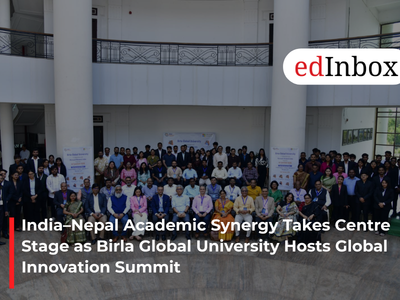
In a significant push toward reimagining global education through local solutions, Birla Global University hosted the International Conference on Grassroots and Frugal Innovations in Emerging Economies (GFI 2026) from March 12 to 14, bringing together a diverse coalition of global academicians, policymakers, and entrepreneurs.
At a time when universities everywhere are expected to come up with sustainable and inclusive solutions, the conference really focused on grassroots and frugal innovation as powerful means of linking local issues with global influence. The event held by Birla School of Management's B-Hive, along with international collaborators such as Syracuse University and Mid-West University, illustrated how international academic partnerships are becoming a key factor in the progress of education systems ready for the future.
A highlight of the conference was the rearrangement of a Memorandum of Understanding (MoU) between Birla Global University and Mid-West University that was done in the presence of the gathering. The MoU will mainly facilitate academic collaboration through exchanges of faculty and students, joint research projects, and entrepreneurship development programs - a move that is in line with the growing trend of South Asian institutions setting up regional knowledge networks.
Vice-Chancellor Kulbhushan Balooni during his speech at the opening session highlighted that, India has always been a big innovator at the grassroots level and the country has been leveraging it continuously to solve the problems of the world. Dhruba Kumar Gautam, the Vice-Chancellor of Mid-West University, on the other hand, suggested that there should be a collaboration via platforms through which emerging economies can co-create scalable and sustainable solutions.
The conference was made up of a number of technical sessions that discussed issues like sustainable innovation ecosystems, climate-smart agro-economies, and leveraging grassroots models for inclusive growth, among otherthings that are being gradually recognized as the main focus of global education. These talks indicated the altering role of universities from simple knowledge distributors to innovation hubs that tackle societal problems. In addition to academic discussions, the Idea2Impact Bootcamp and Innovation Showcase were activities through which the students got involved in turning their creative ideas into real business ventures, thereby aligning with the global education trend of learning through practice and entrepreneurship.
Among other top-notch institutes such as the Indian Institute of Management Ahmedabad, the conference attracted a number of leading global scholars and innovators who shared their insights on various topics. Considering the challenges facing universities today such as climate change, widening inequalities, and the rapid pace of technological change, one can conclude from GFI 2026 and the like that the future of global education is in scaling the ideas that are simple, sustainable, and social-impact-driven.