
A team led by Manipuri astrophysicist Ronaldo Laishram has discovered a massive structure of young galaxies dating back nearly 12.6 billion years, shedding new light on how galaxies formed and evolved in the early Universe.
The discovery, published in The Astrophysical Journal Letters, identifies a giant protocluster named the “Loktak Protocluster,” inspired by Loktak Lake, the largest freshwater lake in Northeast India. Astronomers describe protoclusters as early-stage galaxy clusters — vast collections of galaxies that are still assembling under the influence of gravity in the young Universe.
The newly identified structure dates back to a period only around 1.2 billion years after the Big Bang, making it one of the oldest known large-scale galaxy formations ever observed. Scientists believe such protoclusters eventually evolve into enormous galaxy clusters containing thousands of galaxies.
Researchers say the Loktak Protocluster provides a rare opportunity to study how matter was distributed and how galaxies interacted during the Universe’s formative stages. The structure contains rapidly forming young galaxies, offering clues about star formation, cosmic evolution, and the role of dark matter in shaping the Universe.
The finding is particularly significant because observing such distant objects allows astronomers to effectively look back in time. Since light from the protocluster travelled for 12.6 billion years before reaching Earth, scientists are seeing the structure as it existed in the ancient Universe.
Astronomers often compare protoclusters to “cosmic cities” in development, where galaxies are still gathering and merging through gravitational attraction. Over billions of years, these regions are expected to mature into the massive galaxy clusters observed in the present-day Universe.
The naming of the structure after Loktak Lake also highlights the growing contribution of scientists from India’s Northeast to global astrophysics research. Researchers noted that the discovery demonstrates how advanced observational astronomy is helping scientists reconstruct the earliest chapters of cosmic history.
The study is expected to contribute to broader efforts to understand galaxy assembly, large-scale cosmic structures, and the environmental conditions that shaped the evolution of the Universe shortly after the Big Bang.
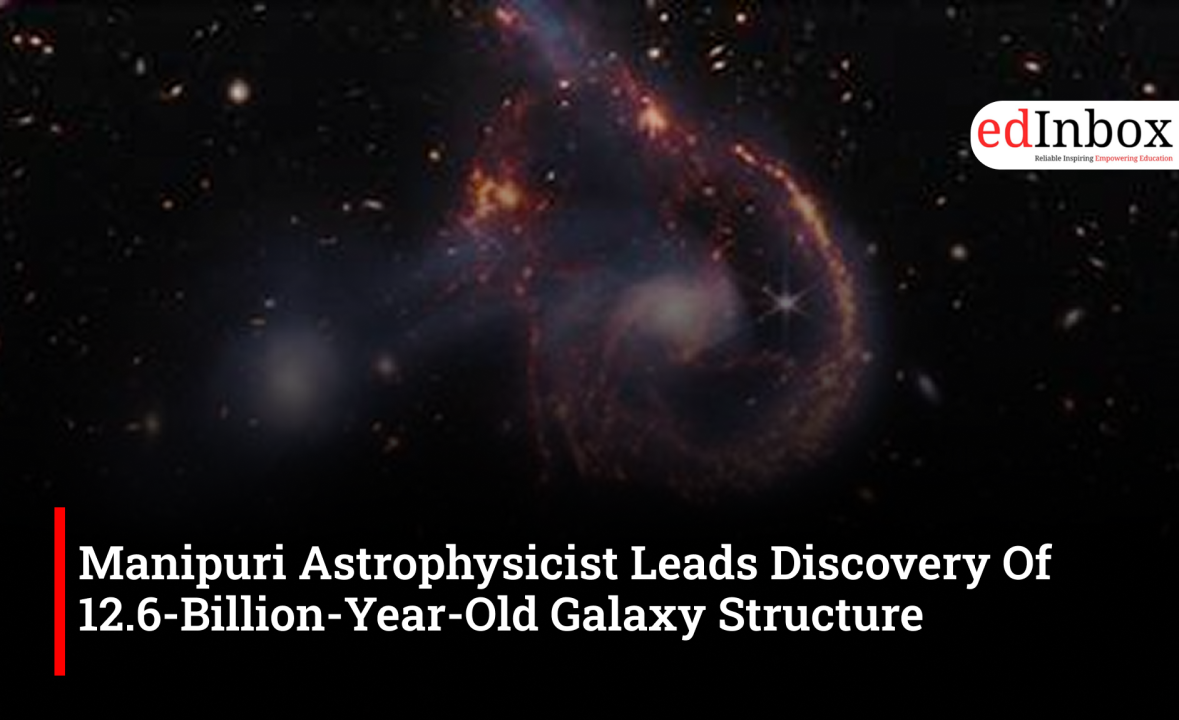
Manipuri Astrophysicist Leads Discovery Of 12.6-Billion-Year-Old Galaxy Structure
Typography
- Smaller Small Medium Big Bigger
- Default Helvetica Segoe Georgia Times
- Reading Mode