
Globally, allied dental professionals—dental hygienists, assistants, and laboratory technicians form the backbone of modern dental practice. In India, however, their presence remains largely theoretical. In an interview with Edinbox, Dr Monalisa Ghosh, an Oral Medicine and Radiology specialist with expertise in CBCT and advanced dental diagnostics, speaks about allied healthcare in dentistry
1. How critical is the role of allied health care professionals such as dental hygienists, lab technicians and dental assistants in improving patient outcomes in modern dental practice?
If you google this topic, there will be search results showing a myriad of possibilities like educating patients, applying fluorides, taking X-rays etc. such is not the case in India. these
classifications work in foreign settings mostly, here everything is done by the dentists themselves.
Yes, we do have an “assistant” per se, but that person isn’t a qualified dental hygienist. Anyone
with some education can be taught to do the job.
Dental technicians on the other hand play a major role in dentistry. All work related to prosthesis
such as dentures, crowns, habit breaking appliances (anything related to laboratory-based activity) is done by them. They are professionals and patient satisfaction largely depends on the quality of work done by the technicians.
I hope as times are changing, the awareness regarding dental health is on the increase and this
will result in more scope for the allied health professionals in dentistry. With an increase in the patient base, dentists will be able to afford qualified dental assistants / hygienists resulting in an overall better experience for the patient and less workload for the doctor. A win-win situation.
2. With India facing a shortage of trained healthcare workers, how do you see allied healthcare professionals bridging the gap between demand and quality oral healthcare delivery?
Again, as a dentist working for the past 5 years in personal clinics, dental chains and colleges,
I have not seen a professional dental hygienist in action. There are nursing staff in hospital set ups or random people employed as assistants who do majority of the work like sterilizing the
instruments, arranging them as per need, taking an xray, holding the suction, retracting the cheek while the doctor operates on the patient. Honestly, just unpaid labour! So, I don’t see any direct contribution of the allied healthcare professionals in the treatment of a dental patient. Again, on paper these titles sound good, promising but it's purely co-incidental in reality in our country as of now.
3. Do you feel allied healthcare courses receive adequate recognition and regulation compared to mainstream medical and dental degrees? What reforms are urgently needed?
No, most of us in the dental community aren’t aware that there are courses for the said
profession. I remember a twin sister of one of my batchmates doing a course as a dental
technician and we felt sorry for the poor girl thinking what a waste of time that is and how unfair it's going to be for her. The next time I came across this term was during my community posting where we were required to learn the definitions and difference between a dental hygienist and a dental assistant. So, one can only infer what recognition there is for our allied health professionals with regards to dental practice. Even the technicians who work for us locally aren't qualified, most of them have learnt the craft through the years and now have their own labs.
The entire dental community doesn’t get its due recognition. There is no strict regulation regarding licensing or prices. Quack practices are in abundance. No govt jobs available. For context, the rural hospital my husband works in has twenty MOs (medical officers) posted while there’s just 1 dentist. When there is negligence at the highest level, what can we expect of the common people?
Some 800 dental surgeons pass out from our state every year. What are they going to do after?
Most of them set up their private clinics, those with lesser resources join other clinics at a nominal wage. In such cases, how do we expect hiring of dental hygienists or assistants? Those jobs are done by a fresh pass out.
About the Expert
Dr Monalisa Ghosh is an oral medicine and radiology specialist with over eight years of academic and clinical experience in dentistry. She holds a Master of Dental Surgery (MDS) in Oral Medicine and Radiology from Vinoba Bhave University and a Bachelor of Dental Surgery (BDS) from the West Bengal University of Health Sciences.
Currently, Dr Ghosh runs Doctors Dental Clinic in Bandel, West Bengal, and also practices at New Life Line Dental Clinic in Dumdum. She is actively involved in CBCT and digital X-ray reporting for Dant Aarogyashala in Bihar, bringing advanced diagnostic precision to patient care. Previously, she served as a Senior Lecturer at Hazaribagh College of Dental Sciences and Hospital, where she combined clinical practice with academic mentoring.
A recipient of the Best Scientific Paper Award at the National Convention 2018 in Vijayawada, Dr Ghosh has chaired scientific sessions at national conferences and has multiple publications to her credit, including research articles and academic books in oral medicine, endodontics and diagnostic imaging. Her professional interests include CBCT-based diagnosis, oral lesion management and forensic dental studies.
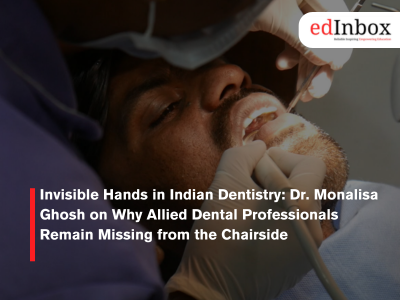
Invisible Hands in Indian Dentistry: Dr. Monalisa Ghosh on Why Allied Dental Professionals Remain Missing from the Chairside
Typography
- Smaller Small Medium Big Bigger
- Default Helvetica Segoe Georgia Times
- Reading Mode