
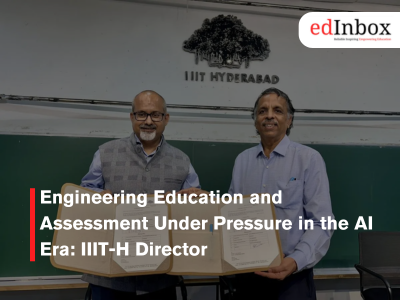
As AI continues to rapidly change classrooms, assessment methods, and career paths, engineering indents across India need to urgently re-invent their teaching and student evaluation methods. In a 1, 1 meeting, Prof. Sandeep K. Shukla, Director of the International Institute of Information Technology Hyderabad (IIIT, H), shares his understanding about how AI is breaking the norms of engineering education, why the traditional assessment model is getting strained, and how institutes have to evolve through research, led learning, cybersecurity projects like Vyuha Labs, and deeper industry collaboration to be able to survive in an unstable technological future.
1. How is artificial intelligence reshaping engineering education and assessment today?Prof. Sandeep K. Shukla: AI, most notably generative and agentic tools, has altered the process of learning and output of work by students drastically. Code, essays, or structured answers can now be written with the help of AI in a very easy way. Educators' real challenge is to find out if students have not only comprehended the concepts but also that they are able to apply them in real, world situations. Hence, worldwide, traditional assessment models have been put under great pressure, including in India, and therefore, institutions are rethinking not only the design of the curriculum but also the evaluation methods.
2.How should Indian engineering colleges adapt their curriculum and assessment in the AI era?
Prof. Shukla: There are a few institutions that are trying out a method where AI is used in exams and assignments along with students submitting prompts and focusing on questions that require conceptual clarity and creative application. We do not have a single solution yet, but the way is clearly indicated, going beyond rote learning to experiential, hands, on and concept, driven education. In the future, AI will be a great tool for personalised learning and adaptive assessments. Curricula will have to be updated continuously as AI progresses.
3.With the launch of Vyuha Labs, how is IIIT, H contributing to national cybersecurity efforts?
Prof. Shukla: Cybercrime has been one of the main causes of anxiety in India and the situation is getting worse every year. Fraud based on social engineering is particularly problematic. Vyuha Labs is committed to investigating various areas of cybercrime to better understand the criminals' tactics and techniques. These crimes are hard for law enforcement to solve since perpetrators successfully hide their traces in an ocean of data, while victims have a hard time explaining targeted and complicated attacks they experienced recently. The Cybercrime Navigator is a tool that helps law enforcement create a map of a crime based on victims' stories. Data analytics also gives the police a better overview of crime trends and hotspots. In addition to that, the lab is working on technology to transcribe calls to the cybercrime helpline in different languages, and it also converts digital evidence into texts for easy analysis. Furthermore, the lab is engaged in law enforcement training and development of native forensic tools to keep pace with criminals and countermeasures in the cybersecurity domain.
4.How does IIIT-H balance cutting-edge research with teaching and student outcomes?
Prof. Shukla: IIIT-H is organised around research labs rather than traditional departments. Faculty integrate active research directly into teaching, and students are associated with research or translational centres from their second year. This early exposure leads to strong research output, innovation, IP creation and global academic competitiveness.
- What skills must students develop to succeed in a rapidly changing technology landscape? Prof. Shukla: Technical skills are only relevant for a certain period of time. The most important skill is the ability to keep learning, adapting and changing oneself. Resilience, communication, teamwork and the ability to deal with change without getting nervous are the most important skills for a future of success.
- How important are industry partnerships in engineering education today?
Prof. Shukla: Industry engagement is critical. It helps shape relevant curricula, ensures research addresses real-world problems, and enables innovation with practical impact. Strong industry links help institutions prepare students for today’s jobs while equipping them for tomorrow’s challenges.
Engineering Education and Assessment Under Pressure in the AI Era: IIIT-H Director
Typography
- Smaller Small Medium Big Bigger
- Default Helvetica Segoe Georgia Times
- Reading Mode