
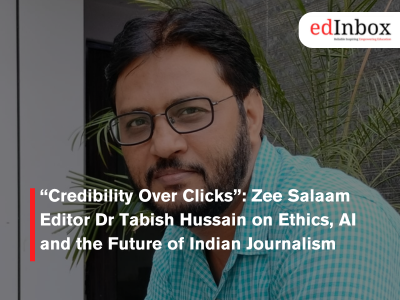
In an era where breaking news is measured in seconds, TRPs dictate newsroom priorities, and artificial intelligence is reshaping content creation, journalism stands at a critical crossroads. Speed has never been faster, but trust has never been more fragile. EdInbox Communication’s Pooja Khanna engages in a thought-provoking conversation with Dr Tabish Hussain, Editor at Zee Salaam TV, to unpack the evolving challenges facing Indian media. Drawing from over two decades of experience, Dr Hussain reflects on how mindset, not just technology, has transformed journalism, why credibility remains the industry’s most valuable currency, and how ethical reporting must anchor newsrooms amid digital disruption. This conversation is especially relevant for students and young media professionals, reminding them that while credibility takes years to build, it can be lost in minutes and that the future of journalism depends not on platforms or algorithms, but on principles, courage and conscience.
Q.1- Dr.Tabish having witnessed Indian journalism evolve over two decades, what do you think has changed the most technology or mindset?
Technology has changed rapidly but the real shift has been in mindset. Earlier, journalism was about patience verifying facts, building sources and understanding context. Today speed often dictates decisions. The challenge is to ensure the technology empowers journalism not to weaken its ethics.
Q.2 - We often hear about the breaking news culture. Do you feel speed has compromised credibility
Ans- Speed is not the enemy, lack of responsibility is. Breaking news should not mean breaking trust. Media houses must remember that credibility ,once lost is almost impossible to regain.
Q.3- As an editor, how do you balance TRP pressure with editorial integrity?
Ans- An editor’s real test begins under pressure. TRP’s matter ,but they should never dictate truth. Editorial independence is non negotiable. If media becomes purely market driven it stops being journalism and becomes entertainment.
Q.4- Digital and Social Media have democratized voices. Is that a strength or a threat?
Ans- Both. It is empowering because more voices are heard, but dangerous because misinformation spreads easily. This is where professional journalism must act as a filter not a megaphone.
Q.5- How do you see the role of AI and technology in Indian newsrooms?
Ans- AI can assist in data analysis ,archiving and research but editorial judgement must remain human. Journalism is about empathy ethics and lived realities things machines cannot replicate.
Q.6-From Edinbox’s Student audience perspective what skills should aspiring journalists focus on today?
Ans- Storytelling. verification adaptability and emotional intelligence. A degree alone is not enough. Students must learn how to think about questions and unlearn when needed.
Q.7- Language media is growing rapidly. How important ate platforms like Zee Salaam in today’s media eco system.
Ans- Extremely important. Language media connects directly with people’s realities. It humanizes news and brings authenticity that often gets lost in elite narratives.
Q.8 Do you feel Indian youth is consuming news emotionally or consciously?
Ans- Mostly emotionally and this is understandable. But media literacy must be encouraged. Youth should be taught how to question narratives, news does not mean that you have to consume the way it has been shown.
Q.9- What ethical boundaries should India media never cross?
Ans- Never compromise facts, never exploit fear and never dehumanize subjects for rating. Journalism is called the fourth pillar of society. Journalism is meant to serve society not to divide it.
Q.10- Finally, what message would you like to give to young storytellers reading Edinbox.
Ans- Journalism is not a short cut to fame. Nowadays social media is flaunting and getting fame overnight. But that is not the real face of the media. It is a long journey of responsibility. If your intent is honest your voice will eventually be heard.
The future of media depends not on platforms, but on principals. Conversations like these remind us that journalism is still rooted in values courage and conscience.
Credibility Over Clicks”: Zee Salaam Editor Dr Tabish Hussain on Ethics, AI and the Future of Indian Journalism
Typography
- Smaller Small Medium Big Bigger
- Default Helvetica Segoe Georgia Times
- Reading Mode