
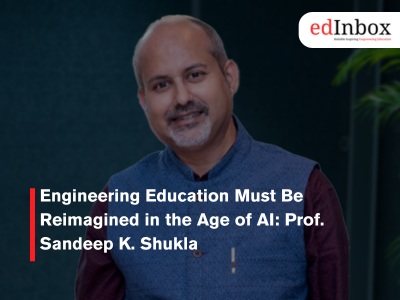
A conversation with Prof. Sandeep K. Shukla, Director, IIIT Hyderabad with Raish Ahmed Laali
As artificial intelligence (AI) rapidly reshapes classrooms, assessment methods, and career pathways, engineering institutions across India are being compelled to urgently rethink how they teach and evaluate students. In this conversation, Prof. Sandeep K. Shukla, Director of the International Institute of Information Technology, Hyderabad (IIIT-H), explains how AI is dismantling long-held assumptions in engineering education, putting pressure on traditional evaluation models, and why institutions must reinvent themselves through research-driven learning, projects like the Vyuh Labs in cybersecurity, and deeper industry collaborations to remain relevant in an uncertain technological future.
How is AI reshaping engineering education and assessment today?
Prof. Sandeep K. Shukla:
AI, especially generative and agentic tools, has completely transformed how students learn and produce outputs. Writing code, drafting essays, or generating structured answers has become much easier with AI assistance. This creates a major challenge for teachers: how to ensure that a student hasn’t just produced an answer, but has actually understood the concept and can apply it in real-world contexts.
This is why traditional assessment models are under immense pressure—not just in India, but globally. Institutions are now being forced to rethink not only curriculum design but also the very methods of evaluation.
What changes should Indian engineering colleges make in their curriculum and assessments?
Prof. Shukla:
Some institutions are experimenting with allowing the use of AI in exams and assignments, while also asking students to submit their prompts. The focus of questions is shifting toward conceptual clarity and creative application.
There is no single solution yet, but the direction is clear: moving away from rote learning toward experiential, hands-on, and concept-driven education. In the coming years, AI will become a powerful tool for personalised learning and adaptive assessment. As AI evolves, curricula will need continuous updating.
How is IIIT-H contributing to national cybersecurity through Vyuh Labs?
Prof. Shukla:
Cybercrime has become a major concern in India, and the problem is worsening each year—especially fraud driven by social engineering. Vyuh Labs aims to research different dimensions of cybercrime so we can better understand criminals’ strategies and methods.
These crimes are complex because perpetrators hide their tracks in vast oceans of data, while victims struggle to explain the nature of the highly targeted and sophisticated attacks they face.
The Cybercrime Navigator is a tool that helps law enforcement agencies map crimes based on victim inputs. Through data analytics, police can better understand trends and hotspots.
The lab is also working on technologies to transcribe cybercrime helpline calls in multiple languages and convert digital evidence into text for easier analysis. Additionally, it is developing indigenous forensic tools and training law enforcement agencies to tackle cybercriminals more effectively.
How does IIIT-H balance research, teaching, and student outcomes?
Prof. Shukla:
IIIT-H is structured around research labs rather than traditional departments. Faculty integrate their active research directly into teaching, and students begin engaging with research or translational centres from their second year itself.
This early exposure enables strong research output, innovation, intellectual property creation, and global academic competitiveness.
What skills will students need in a rapidly changing technological world?
Prof. Shukla:
Technical skills have a limited shelf life. The most important skill is the ability to continuously learn, adapt, and reinvent oneself. Flexibility, communication, teamwork, and the ability to work through change without panic will define success in the future.
How important are industry partnerships in engineering education today?
Prof. Shukla:
Industry engagement is critical. It keeps curricula relevant, ensures research focuses on real-world problems, and gives innovation practical impact. Strong industry partnerships don’t just prepare students for today’s jobs—they equip them for the challenges of tomorrow.
Engineering Education Must Be Reimagined in the Age of AI: Prof. Sandeep K. Shukla
Typography
- Smaller Small Medium Big Bigger
- Default Helvetica Segoe Georgia Times
- Reading Mode