
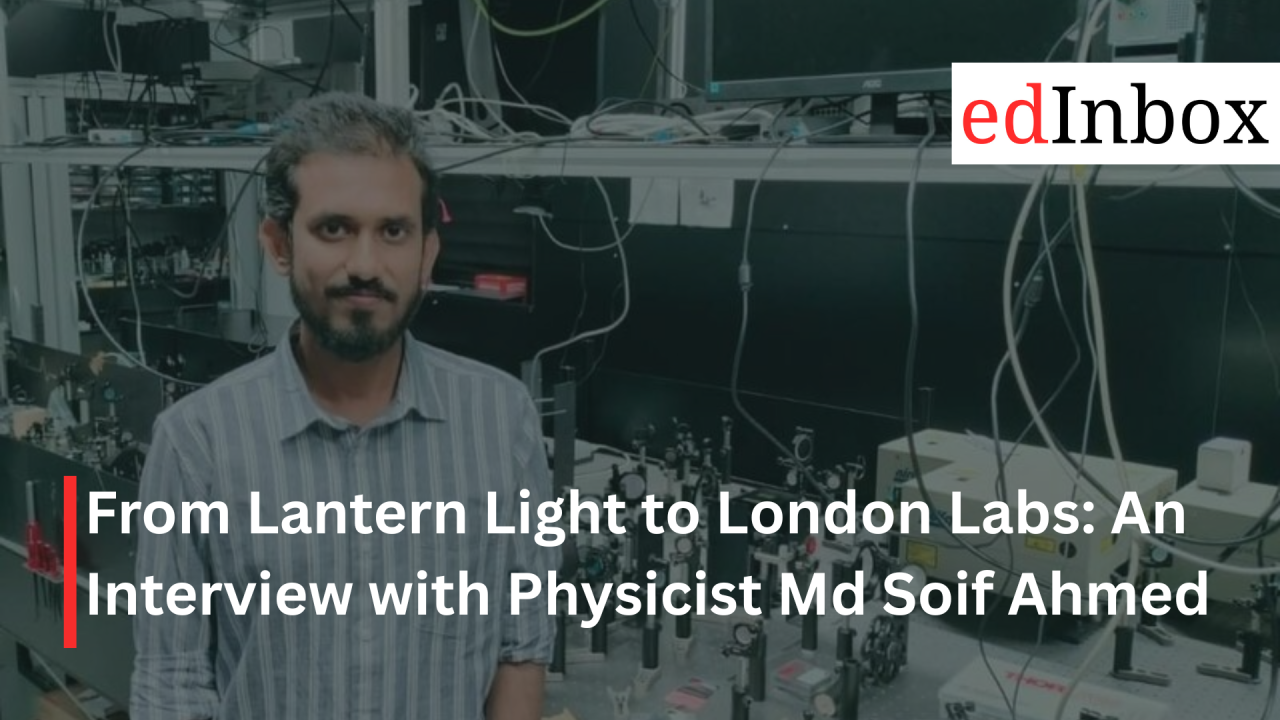
At just 30, Md Soif Ahmed is preparing to lead his own research project at Imperial College London under the prestigious Marie Skłodowska-Curie Actions Postdoctoral Fellowship. But his journey began far from high-end laboratories—in a village home in Murshidabad that didn’t even have electricity.
Q: You grew up without electricity. What do you remember most about those early years?
I didn’t have electricity at home until Class 8. We used a lantern for general light and a small lamp for studying. My grandfather did what he could afford. At the time, it didn’t feel unusual—it was just life. Looking back, I realise how much those conditions shaped my discipline and focus.Q: Tell us about your early schooling experience.
I studied at a government school in Komnagar where there was barely any infrastructure. There was one building used as an office, and we attended classes sitting on jute mats under a mango tree. But learning was never compromised. In fact, those years were very formative.Q: How did your family influence your education?
I grew up in a joint family with five school-going children. We studied together and helped each other. If I had a doubt in mathematics, I would ask my maternal uncle; for English, my aunt helped me. It was a collaborative learning environment. We didn’t see our financial struggles as obstacles.Q: You’ve spoken about financial hardship. How did that affect your daily life?
We lived very simply. We never really had breakfast—maybe a biscuit or some sattu before school. We ate whatever was available locally. Sometimes it was raw bananas or jackfruit for days. Fish was rare, and mutton even rarer. But again, we never felt deprived. Education and play were our priorities.Q: When did things begin to change for your family?
A major turning point was when my father got a job as a school teacher. That brought stability. We moved into a new house, and for the first time, we had electricity. It changed our lives in many ways, including my ability to study better.Q: How did your academic journey progress after school?
After Class 10, I moved to Kolkata for higher secondary education. It was a big step for my family. I later joined Aliah University for an integrated MSc in Physics, which I completed in 2018. That’s where I seriously began considering research as a career.Q: What led you to pursue a PhD at Indian Institute of Technology Hyderabad?
Clearing GATE opened that door. Moving out of West Bengal for the first time was a big shift, but IIT Hyderabad gave me the platform to grow. My supervisor, Sai Santosh Kumar Raavi, was extremely supportive.Q: Could you explain your research in simple terms?
My work focuses on how materials behave when exposed to light, especially using ultrafast laser pulses. This helps us understand and improve technologies like solar cells, LEDs, and photodetectors. It’s about making devices more efficient.Q: Where are you working currently?
I’m currently a postdoctoral researcher at IMDEA Nanosciencia in Spain. It’s an interdisciplinary space where physicists, chemists, and biologists collaborate to study advanced materials.Q: What does the Marie Curie Fellowship mean to you?
It’s a huge opportunity. From November, I’ll be working at Imperial College London, leading my own research project. It’s a step closer to my long-term goal of building my own research group in India, ideally at an IIT or a leading institute.
Q: Looking back, did you ever imagine this journey?
Not at all. Till Class 10, I didn’t even know what IITs or PhDs were. My only goal was to top my class. Everything else followed step by step.
From studying under a mango tree to leading research in one of the world’s top institutions, Ahmed’s journey is a testament to how perseverance and curiosity can transcend circumstances.
From Lantern Light to London Labs: An Interview with Physicist Md Soif Ahmed
Typography
- Smaller Small Medium Big Bigger
- Default Helvetica Segoe Georgia Times
- Reading Mode