
At a time when education is increasingly measured through placements, salaries, and competitive success, educationist Sushma Paul Berlia has argued that the true purpose of learning goes far beyond marksheets and job readiness. According to her, education must focus on shaping compassionate, ethical, and responsible human beings capable of contributing meaningfully to society.
Speaking on the changing role of education in the modern era, Berlia said the deeper objective of schooling is to prepare students not only for livelihoods but for life itself. She emphasised that while academic achievement and professional success remain important, qualities such as empathy, integrity, resilience, self-discipline, and moral courage are equally essential in a rapidly changing world.
Her remarks come amid growing global conversations around the future of education in the age of artificial intelligence, misinformation, and digital disruption. Berlia noted that the challenge for students today is no longer limited to accessing information, but learning how to distinguish truth from distortion in an increasingly complex digital environment.
According to Berlia, value systems cannot be developed solely through textbooks or formal lessons. Instead, she believes values are absorbed through culture, behaviour, and lived experiences within educational institutions.
At Apeejay Education, she said value-based learning is integrated into everyday school life through activities such as mindfulness practices, yoga, assemblies, creative arts, environmental initiatives, and community outreach programmes. The idea, she explained, is to create educational spaces where students learn not only to compete, but also to coexist, collaborate, and contribute responsibly.
Berlia also stressed the importance of nurturing responsible global citizens at a time when societies across the world are becoming increasingly interconnected yet polarised. She argued that education systems must encourage students to think beyond individual achievement and understand their role in addressing broader social and environmental challenges.
Education experts say her observations reflect a wider shift taking place globally, where schools and universities are being urged to balance employability with emotional intelligence, ethics, and social responsibility. With artificial intelligence increasingly automating technical tasks, many educators believe human qualities such as empathy, creativity, adaptability, and ethical reasoning may become even more valuable in the future workforce.
As debates around education reform continue, Berlia’s message reinforces a growing belief among educators that the success of an education system should not be judged only by examination results or placement figures, but by the kind of human beings it helps create.
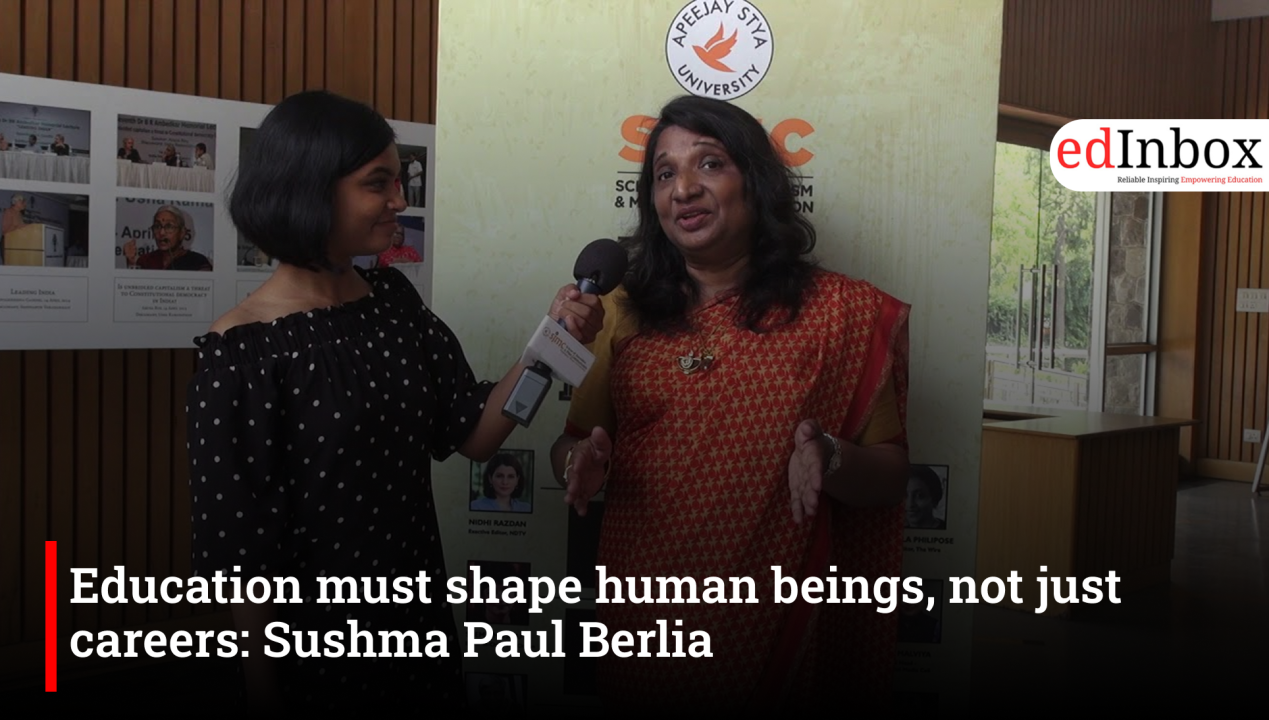
Education must shape human beings, not just careers: Sushma Paul Berlia
Typography
- Smaller Small Medium Big Bigger
- Default Helvetica Segoe Georgia Times
- Reading Mode