
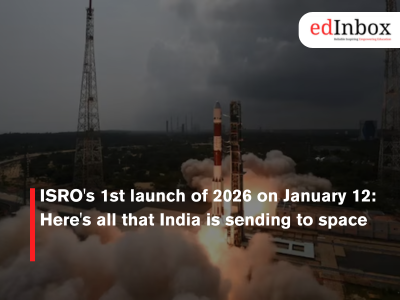
The Indian Space Research Organisation (Isro) is set to launch the PSLV-C62 mission on January 12, 2026 from Sriharikota. This mission, blasting off at 10:17 am IST, will carry a primary Earth observation satellite alongside 18 intriguing co-passengers from around the world.
From defence tech to artistic experiments in orbit, these payloads promise to push boundaries in science and innovation. Let us dive into the stars of the show.
EOS-N1 (ANVESHA)
At the heart of the mission is EOS-N1, also known as Anvesha, a sophisticated imaging satellite crafted by the Defence Research and Development Organisation (DRDO).
Weighing in at a hefty load, it focuses on strategic applications like border surveillance and identifying hidden assets through hyperspectral imaging. This is an imaging technique which gives a camera super vision to see not just colours, but hundreds of invisible light shades across the electromagnetic spectrum.
Imagine a satellite that can peer through camouflage, aiding national security while also supporting agriculture and environmental tracking. It is a game-changer for India's remote sensing prowess.
AAYULSAT
Hailing from Bengaluru's space technology startup OrbitAID Aerospace, AAYULSAT is India's bold first step into on-orbit refuelling. This compact satellite demonstrates how we might extend spacecraft lifespans by topping up fuel in space, much like refilling one's car on a long road trip.
MOI-1
Developed by Hyderabad's TakeMe2Space and EON Space, the 14-kilogram MOI-1 packs a punch with onboard AI for Earth imaging.
It processes data right in orbit, skipping the need for ground stations. Think of it as a smart camera in the sky, spotting changes in landscapes or disasters in real time, showcasing edge computing's orbital potential.
INDO-MAURITIUS JOINT SATELLITE (IMJS)
This collaborative gem between India and Mauritius highlights growing international ties. While details are sparse, IMJS symbolises shared ambitions in space exploration, possibly focusing on regional monitoring.
It is a reminder that space knows no borders, fostering technology exchanges across oceans.
KESTREL INITIAL DEMONSTRATOR (KID)
From Spain's Orbital Paradigm comes the 25-kilogram KESTREL INITIAL DEMONSTRATOR (KID), a reentry capsule hitched to the rocket's fourth stage.
It tests low-cost recovery for microgravity experiments, like bringing samples back from space affordably.
Picture a football-sized probe plummeting home, opening doors to reusable tech.
ORBITAL TEMPLE
A quirky 250-gram PocketQube from an artistic project, Orbital Temple challenges ideas of space as a 'heavenly' realm.
This tiny cube, orbiting at 525 kilometres, probes cultural beliefs about the cosmos. It is not just science; it is philosophy in space, lingering for a decade to spark debates on humanity's stellar footprint.
PocketQube is an artistic project by Brazilian artist Edson Pavoni, serving as a space memorial where people can upload names of loved ones via a ground-based antenna.
The satellite platform was developed by Morehead State University and Kentucky Space in the US.
The PocketQube satellite serves as an open memorial in space, inviting anyone on Earth to send the name of a loved one who has passed away. Through a simple website, participants submit names for free, which are then beamed up via radio signals from a striking golden ground antenna to be stored eternally in the satellite's memory as it orbits at around 525 kilometres altitude.
What makes Orbital Temple truly captivating is its deeper message. It gently challenges long-held cultural and religious ideas about heaven.
This project is to democratically determine who is able to gain access to the space above Earth and to provide a welcoming, open environment for everyone, everywhere, in a manner similar to how we operate on Earth. It gives people a way to honour the memory of loved ones that have passed away while providing a place for reflection on topics such as grief, remembrance, and humankind's role in the universe.
The payload will remain in orbit for approximately 10 years and will eventually fall back to Earth and burn up in the atmosphere, leaving no trace behind; this is a very considerate acknowledgment of human frailty and of the need to act responsibly.
The rest of the CUBE satellites and the other 200 kilograms of satellite payloads, CGUSAT-1, SR-2 Sat, and the other CUBE satellites from other countries like UAE and USA are all included in these payloads.
They span startups and institutions, hinting at diverse experiments. With PSLV's proven track record, this launch could inspire a new wave of space enthusiasts.
ISRO's 1st launch of 2026 on January 12: Here's all that India is sending to space
Typography
- Smaller Small Medium Big Bigger
- Default Helvetica Segoe Georgia Times
- Reading Mode