
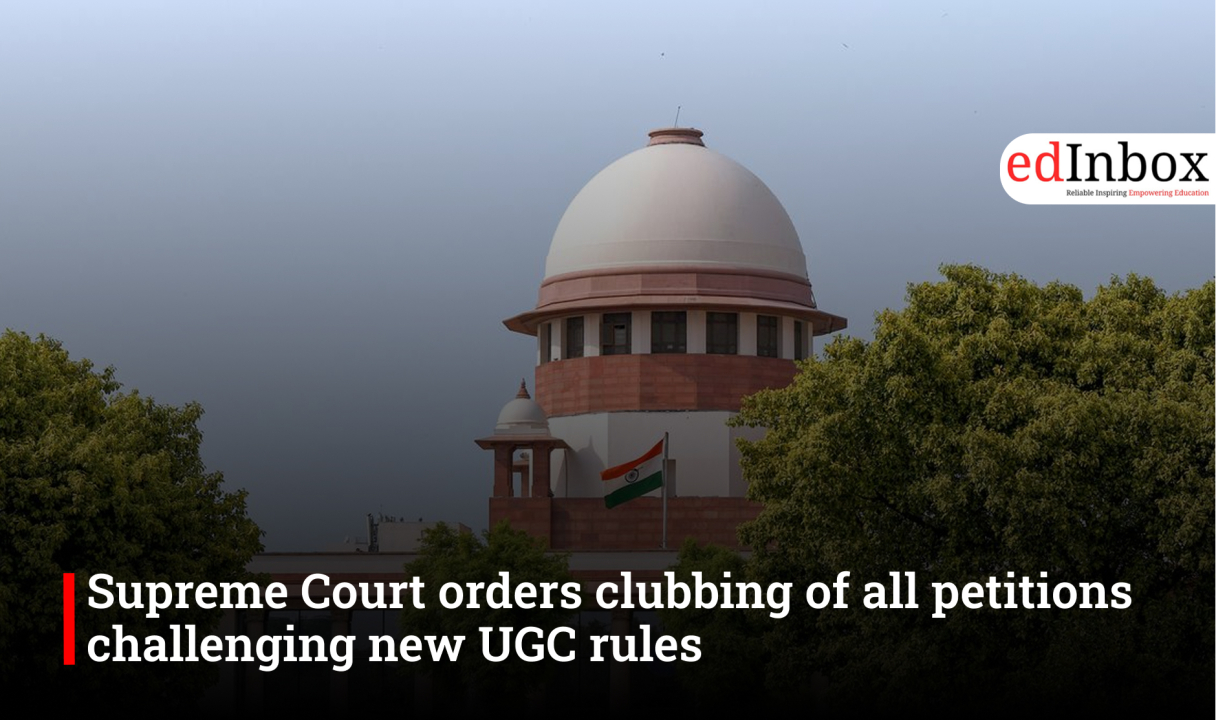
The Supreme Court today served the Central Government and the University Grants Commission (UGC) with notices through two new petitions which challenge the recently announced UGC regulations 2026. The bench ordered that these new petitions be merged with the earlier petitions, and all matters would be collectively heard.
The fresh petitions contend that the new rules discriminate against the general category and violate their fundamental rights. Earlier, the top court had issued notices to the Centre and UGC and stayed the implementation of the regulations. During the proceedings, the court also suggested the constitution of a committee to reconsider the provisions of the UGC rules. A hearing date for the combined petitions will be scheduled shortly.
The UGC regulations 2026, which mandated all universities and colleges in the country to establish an Equal Opportunity Centre (EOC) and campus-level committees to inquire into discrimination complaints and promote equity and inclusion, have been put on hold amid widespread protests, especially from general category students. The bench flagged "complete vagueness" in the rules that makes them prone to misuse.
During the hearing, Chief Justice of India Surya Kant had highlighted the persistence of caste-based discrimination even 75 years after independence.
"In a country after 75 years, all that we have achieved, to become a classless society; are we becoming a regressive society? The worst thing happening in ragging is that children coming from south or north-east... they carry their culture, and somebody alien to this starts commenting on them. Then you have separate hostels. For God's sake. There are inter-caste marriages, and we have also been in hostels where all stayed together," the Chief Justice had remarked.
The bench made it clear that the language of the regulations has to be evaluated by the experts. Justice Joymalya Bagchi, who was on the two, judge bench, brought to light that Article 15(4) authorizes making laws for Scheduled Castes and Scheduled Tribes, but lawmaking with a stepping up attitude should not be stepping back.
I hope we dont go to segregated schools like the U.S. where blacks and whites went to different schools, he said, to which the Chief Justice of India added, This kind of situation can be exploited.
While representing the petitioners, the lawyer Vishnu Shankar Jain submitted that Section 3(c) of the regulations limits the definition of caste, based discrimination only against SCs, STs, and OBCs, thereby excluding the general category, and hence it is against Article 14.
Caste based discrimination is define as discrimination against SC, ST and OBC only. This completely excludes the members of the general category. This definition under Section 3(c) is hit by Article 14, as discrimination cannot be assumed to target only one segment," Jain said.
With the UGC 2026 regulations stayed, colleges and universities must continue following the 2012 rules. The next hearing has been scheduled for March 19.
Supreme Court orders clubbing of all petitions challenging new UGC rules
Typography
- Smaller Small Medium Big Bigger
- Default Helvetica Segoe Georgia Times
- Reading Mode