
The concept of sustainable education is usually mentioned in policy documents and climate debates. However, its significance comes out in the open through daily crisis situations. A recent event in Bengaluru is a good example of how education systems should be geared to helping people adapt to resource disruptions and environmental challenges.
Recently, due to a shortage of LPG cylinders for commercial use, operations of many hotels got disrupted in the city. One such hotel, The Sanctuary Hotel in the Gandhinagar area near the racecourse, faced difficulties in getting the gas supply required for cooking daily. When commercial cylinders were not available, the hotel changed to cooking on traditional wood stoves for a while in order to serve meals to the guests.
The management put up signs asking customers to understand the situation due to the shortage of LPG and also mentioning that the full menu might not be available until the supply returns to normal. The kitchen staff got creative by cooking on wood, fired stoves to carry on with kitchen operations on a minimum level while informing the visitors about the situation and asking for their patience.
The first thought will probably be that it was a mere supply, chain problem. However, it is actually the case that modern urban systems rely heavily on limited resources and centrally organized supply networks. So, when disruptions happen, be it due to logistics, energy shortages, or environmental events, communities will have to depend on adaptability and hands- on knowledge if they want to survive.
This is what makes sustainable education so important. Sustainable education is a means of instructing students about environmental conservation, resource management, alternative technologies, and human resilience, among others. A case in point, studying renewable energy, good cooking systems, and local resource use can enable people and organizations to handle sudden shortages.
Schools in India are progressively making sustainability a part of their syllabi through environmental studies, green campus initiatives, and climate literacy programmes. These programmes attempt to create citizens who know how their everyday decisionsenergy consumption, food, making, waste disposallink to the natural world.
The hotel in Bengaluru switching temporarily to the old ways of cooking indicates that the answers are sometimes in the mix of modern efficiency and old, time knowledge. Sustainable education is all about fostering such a mentality: coming up with new ideas based on the real world of resources.
As urban areas expand and supply chains become vulnerable to climate changes and the rising global demand, sustainability based education is getting more and more important. Equipping the next generation with the ability to analyze energy, food systems and environmental responsibility critically is perhaps as important as acquiring any technical skill.
Ultimately, sustainable education is not only about saving the earth, it is about making sure that people are still able to live their lives even when the regular systems stop working.
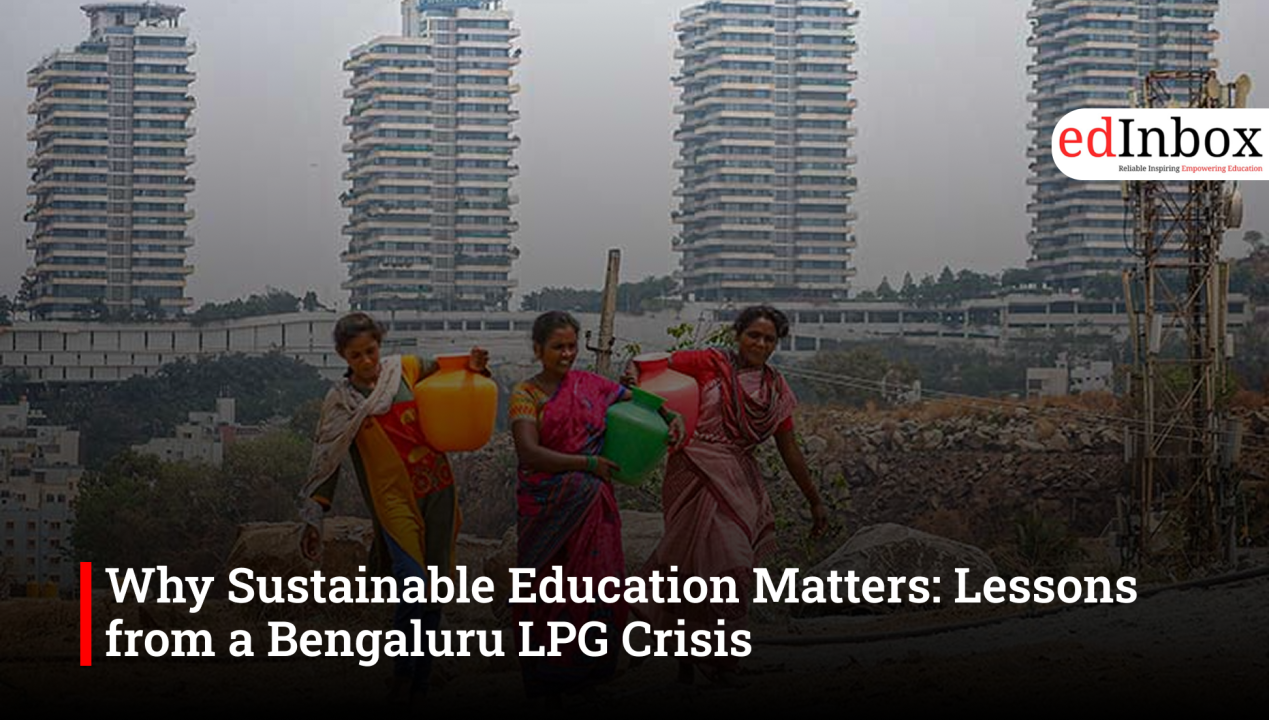
Why Sustainable Education Matters: Lessons from a Bengaluru LPG Crisis
Typography
- Smaller Small Medium Big Bigger
- Default Helvetica Segoe Georgia Times
- Reading Mode