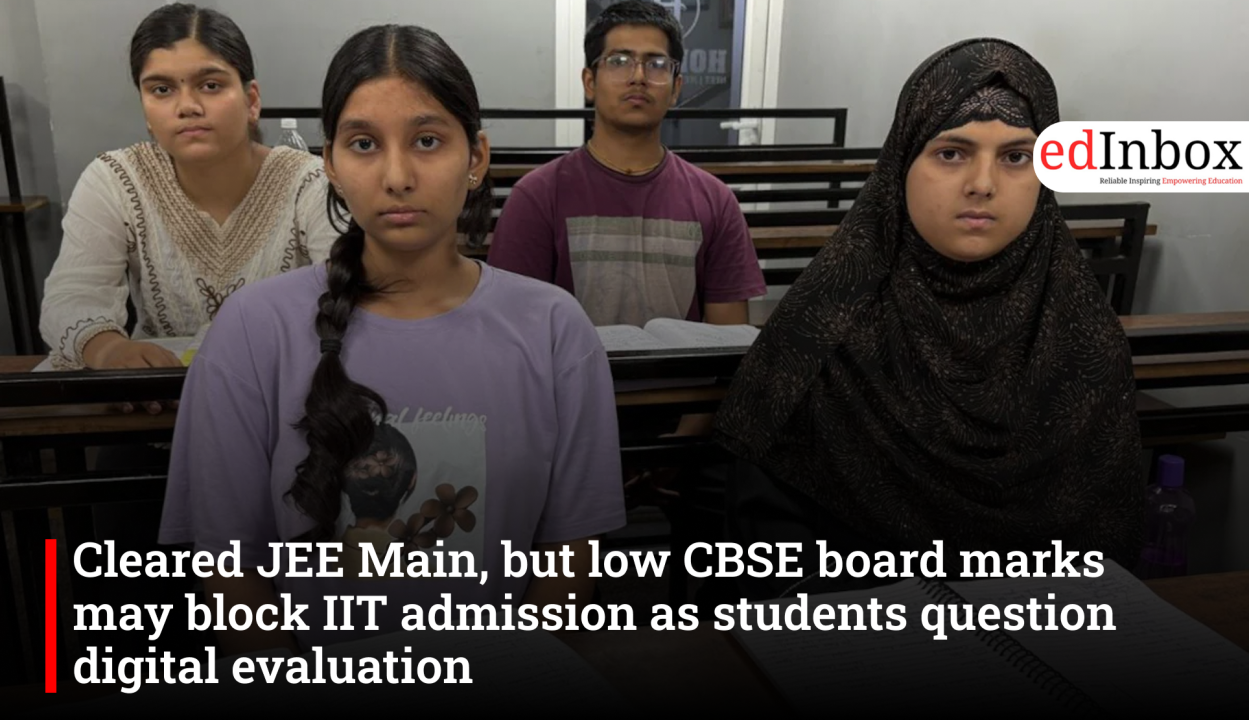
The rollout of Central Board of Secondary Education’s On-Screen Marking (OSM) system has triggered growing anxiety among engineering and medical aspirants after the 2026 Class 12 results recorded a sharp decline in high scorers.
While thousands of students successfully cleared Joint Entrance Examination Main, many now fear they may lose eligibility for admission into the Indian Institutes of Technology and National Institutes of Technology because they failed to cross the mandatory 75% board marks criterion.
The controversy has intensified just days before JEE Advanced 2026.
Students say board marks don’t reflect performance
Among the affected students is Subh Jajoria, a Delhi-based aspirant who cleared JEE Main but scored only 70% in Class 12 boards.
He says his Physics marks came as a shock.
“I was expecting more than 85 in Physics, but I got only 55,” he said, adding that both teachers and parents were stunned by the result.
For students targeting IIT admissions, the stakes are unusually high because qualifying entrance exams alone is insufficient. Candidates must also meet board percentage eligibility requirements.
Subh and his family have now applied for re-evaluation of his answer sheets.
What is CBSE’s On-Screen Marking system?
CBSE introduced the OSM system to digitise evaluation by:
- Scanning answer sheets
- Allowing teachers to mark scripts online
- Automating totalling and tabulation
- Standardising marking schemes
The board says the system improves:
- Accuracy
- Transparency
- Fairness
- Efficiency
But students and teachers argue the transition may have been implemented too quickly and without adequate preparation.
Science students report biggest score drops
Complaints have emerged particularly from students in:
- Physics
- Chemistry
- Biology
- Mathematics
Many aspirants preparing simultaneously for:
- Joint Entrance Examination Advanced
- National Eligibility cum Entrance Test
- Common University Entrance Test
say their board marks were far below expectations.
Farim said her Chemistry score was “shocking” despite confidence about the examination.
Another student, Mehak, who had scored 93% in Class 10 and consistently performed well in school exams, received 86% in Class 12.
She described the experience as emotionally exhausting amid simultaneous preparation for boards and competitive exams.
Teachers raise concerns over rushed rollout
Educators evaluating answer sheets have also questioned the implementation process.
Sanjeev Jha, who has checked CBSE papers for 17 years, said this is the first time he has seen such widespread complaints over unexpectedly low scores.
According to him:
- Teachers received training only shortly before evaluation began
- Some scanned pages appeared blurred or unclear
- Punctuation and handwritten lines were difficult to read digitally
- Margin work and lightly written steps may have been overlooked
He also noted that OSM strictly follows stepwise marking patterns.
This may disadvantage students trained for competitive exams like JEE and NEET, where speed and direct answers are prioritised over detailed written steps.
“In entrance exams, students are trained to write concise answers quickly. But CBSE’s digital system awards marks stepwise,” he explained.
Bigger concern: communication gap
A major criticism from students and parents is that CBSE allegedly failed to clearly communicate how answer-writing expectations would change under digital evaluation.
Many believe schools should have been informed earlier so students could adapt by:
- Writing more structured answers
- Showing all intermediate steps
- Using darker handwriting
- Labelling diagrams clearly
Parents argue that changing evaluation practices without advance preparation has unfairly affected students already balancing intense entrance exam preparation.
Re-evaluation requests surge
Following the backlash, students across India are increasingly applying for:
- Scanned copies of answer sheets
- Verification of marks
- Re-evaluation
CBSE has opened a formal review process, though concerns remain over whether the system itself may have altered scoring outcomes.
The board has so far maintained that OSM improves standardisation and reduces human error.
Why this debate matters beyond one exam cycle
The controversy reflects a deeper shift underway in India’s education system under competency-based assessment reforms linked to National Education Policy 2020.
As evaluation becomes increasingly digital and structured:
- Presentation style matters more
- Stepwise logic is prioritised
- Informal moderation declines
- Subjective examiner variation reduces
For many students, however, the immediate concern is far more personal.
As Subh put it: “A difference of five percent can decide someone’s future.”