
The world of competitive chess is witnessing one of its most significant policy debates in decades after FIDE announced a pilot programme that could allow players to earn their first official over-the-board (OTB) rapid and blitz ratings entirely through online games.
The proposed "First Rating Experiment", launched in partnership with World Chess, aims to make official chess ratings more accessible by enabling newcomers to obtain their initial FIDE ratings through online competition on the World Chess platform. While the initiative seeks to expand the global pool of rated players beyond the current 500,000, it has triggered intense debate among India's leading Grandmasters.
Breaking Down FIDE's New Experiment
Traditionally, earning an official FIDE rating requires participation in FIDE-rated tournaments, where players compete under strict regulations against already rated opponents.
The new two-year pilot seeks to remove many of these barriers by allowing eligible players to obtain their first official rapid and blitz ratings online. To safeguard the system, FIDE plans to use AI-powered fair-play monitoring and a technical coefficient that aligns online performances with over-the-board standards.
Importantly, ratings earned through the experiment will be capped at 1800 Elo, ensuring that players must still prove themselves in traditional tournaments to progress further.
Critics Warn Against Mixing Online and Offline Chess
Several Indian Grandmasters believe that online and over-the-board chess should remain separate.
Grandmaster SL Narayanan described the proposal as an unnecessary move, arguing that online chess operates under entirely different conditions from classical tournament play.
According to him, while recreational players may appreciate easier access to official ratings, blending online and offline performances risks undermining the credibility of the FIDE rating system.
Coach Srinath Narayanan echoed similar concerns, expressing scepticism over the effectiveness of online anti-cheating measures and arguing that official over-the-board ratings should never be linked with internet-based games.
Grandmaster SP Sethuraman also questioned the move, pointing out that chess ratings already experience inflation and deflation across different regions and generations. Introducing online-generated ratings, he warned, could create further inconsistencies in an already complex ecosystem.
Grandmaster Abhimanyu Puranik adopted a more measured approach, noting that while linking online and offline ratings is generally not ideal, the relatively low starting ratings may limit the overall impact.
Fair Play Remains the Biggest Challenge
Veteran coach and Grandmaster Shyam Sundar M acknowledged that FIDE deserves credit for exploring new ideas but expressed reservations about relying entirely on online play.
He suggested that hybrid events—where players compete online from supervised physical venues under arbiter oversight—could offer a better balance between accessibility and security.
His primary concern revolves around anti-cheating systems.
He argued that no fair-play technology should incorrectly accuse innocent players based solely on move quality or game analysis, emphasising that protecting honest competitors must remain a priority.
At the same time, he acknowledged that future advances in artificial intelligence and browser-based monitoring could eventually make such systems more reliable.
Veteran GM Pravin Thipsay Sees a Historic Opportunity
Not every Grandmaster opposes the proposal.
Arjuna Award-winning Grandmaster Pravin Thipsay welcomed the experiment, calling it a bold attempt to bridge the long-standing gap between millions of online chess enthusiasts and the formal competitive circuit.
According to Thipsay, only a tiny fraction of the world's chess players currently have access to FIDE-rated tournaments because of financial, geographical and logistical barriers.
He believes the 1800 rating ceiling provides an effective safeguard while encouraging talented online players to transition into over-the-board competition.
However, he also cautioned that the experiment's success will depend heavily on accurate rating calculations and strong anti-cheating safeguards, recalling that previous rating reforms had produced unintended consequences.
A Defining Moment for Modern Chess
FIDE's proposal represents one of the most ambitious attempts to modernise competitive chess in the digital era.
Supporters argue that it could dramatically increase participation by making official ratings accessible to millions who cannot regularly attend tournaments. Critics, however, believe that even sophisticated AI cannot yet replicate the integrity and playing conditions of over-the-board chess.
As FIDE gathers community feedback ahead of the programme's planned rollout, the experiment has become a defining test of whether technology can expand access to the game without compromising the credibility of one of chess's most valued benchmarks—its rating system.
Whether the initiative proves revolutionary or controversial, it has already succeeded in sparking one of the biggest conversations in modern chess.
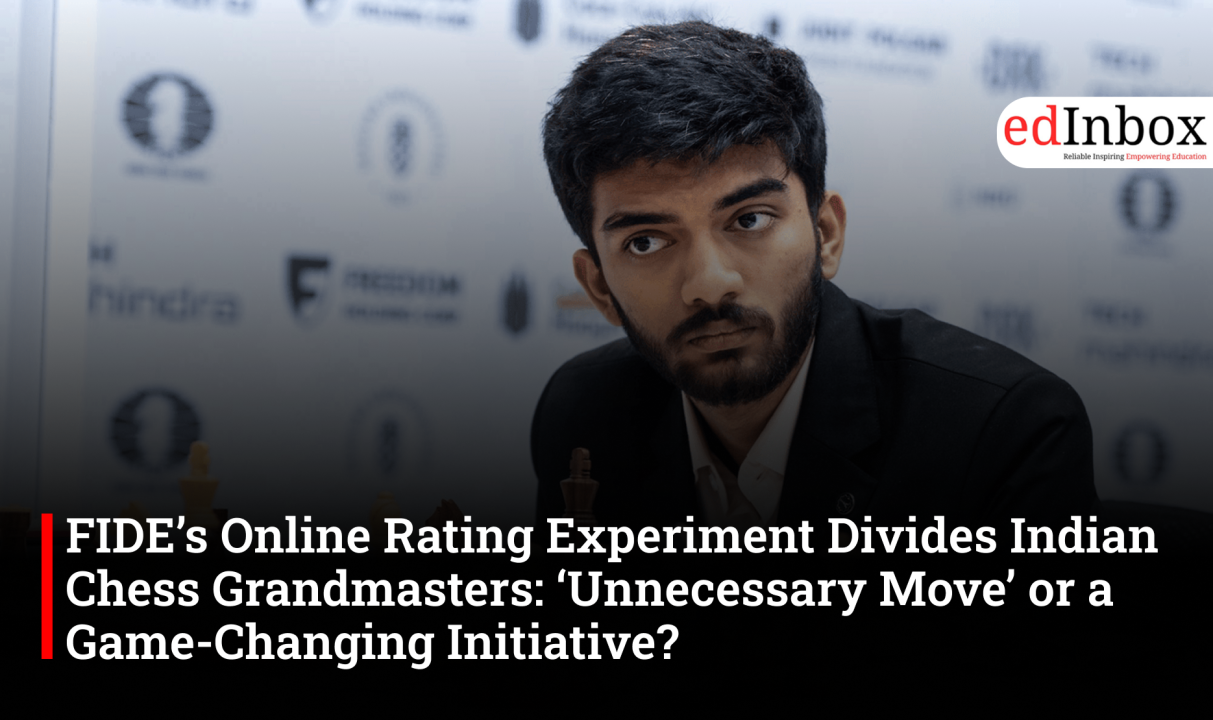
FIDE’s Online Rating Experiment Divides Indian Chess Grandmasters: ‘Unnecessary Move’ or a Game-Changing Initiative?
Typography
- Smaller Small Medium Big Bigger
- Default Helvetica Segoe Georgia Times
- Reading Mode