New Delhi: The Central Board of Secondary Education’s (CBSE) new three-language policy for Class 9 students has reached the Supreme Court, with a fresh legal challenge questioning its constitutional validity and educational rationale.
The petition has been filed by educationist and NCP (Sharad Pawar faction) leader Fauzia Khan, who has argued that the policy is arbitrary, impractical and inconsistent with the spirit of the National Education Policy (NEP) 2020.
What the Petition Challenges
The plea targets a CBSE circular issued on May 15, which mandates that Class 9 students study three languages from July 1 onwards, with at least two Indian languages.
According to the petition, the rule effectively forces schools in non-Hindi-speaking states to introduce Hindi, while institutions in northern states may be pushed toward Sanskrit, without adequate academic justification or resources.
The petitioner also highlighted a key contradiction: while CBSE acknowledges a shortage of qualified language teachers, it still proceeds with mandatory implementation.
Foreign Language as Fourth Option Only
Under the new framework, students may opt for a foreign language only as a fourth subject, provided they have already studied two Indian languages.
The policy aligns with NEP 2020 and the National Curriculum Framework for School Education (NCF-SE) 2023, both of which promote multilingual learning and exposure to Indian languages.
Concerns Over Feasibility and Equity
The petition argues that the mandate could disproportionately affect students in linguistically diverse states, particularly in South India, where concerns over compulsory Hindi instruction have historically triggered political and educational debates.
It further claims that the policy may not be implementable in many schools due to a lack of trained teachers, infrastructure and learning materials.
Supreme Court Already Seized of Matter
The Supreme Court had earlier issued notice on a similar petition challenging the CBSE’s language policy on May 27, indicating that the issue is already under judicial consideration.
With the latest plea, the legal scrutiny over the three-language formula is expected to intensify in the coming weeks.
CBSE’s Stand Through Policy Alignment
CBSE has defended the policy as part of its broader alignment with NEP 2020 and NCF-SE 2023, which emphasize multilingual proficiency as a key educational goal.
The board maintains that learning multiple languages enhances cognitive development and cultural understanding among students.
A Wider Debate on Language and Education
The case has reignited a long-standing national debate over language policy in school education, balancing constitutional diversity with national curriculum standardisation.
As the matter progresses in the Supreme Court, the outcome could have significant implications for how languages are taught across India’s school system, particularly in CBSE-affiliated institutions.
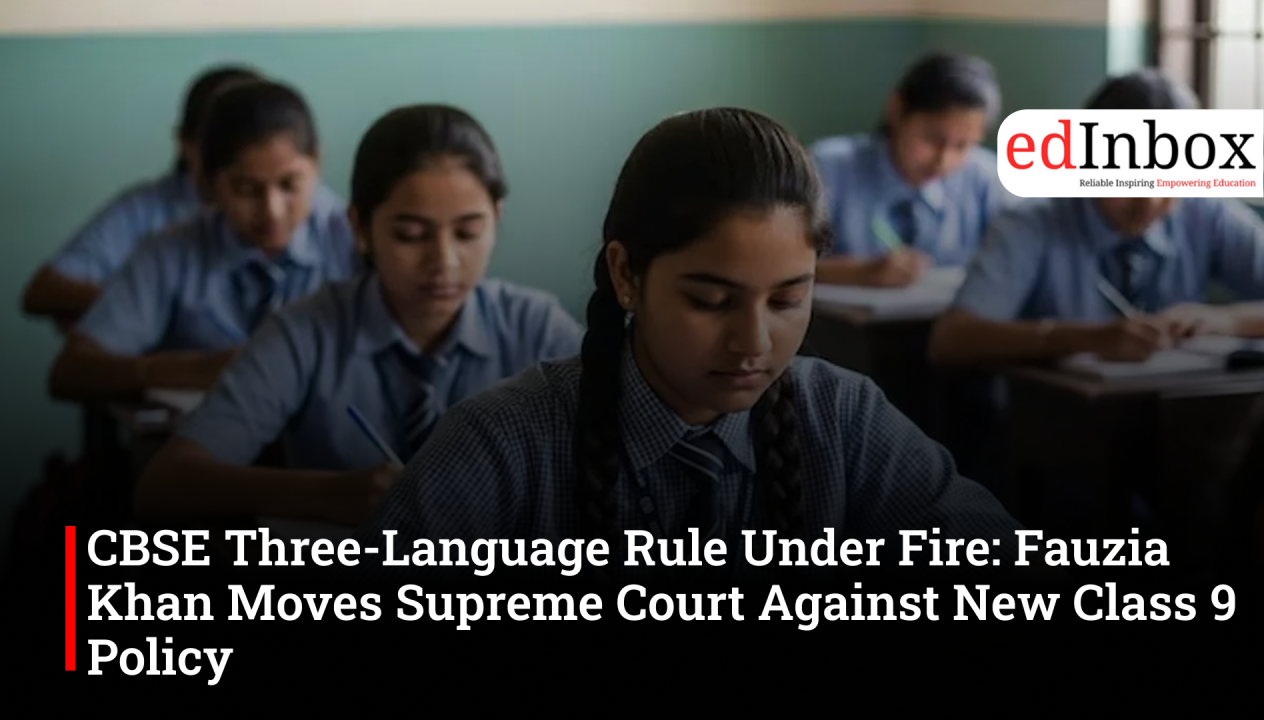
CBSE Three-Language Rule Under Fire: Fauzia Khan Moves Supreme Court Against New Class 9 Policy
Typography
- Smaller Small Medium Big Bigger
- Default Helvetica Segoe Georgia Times
- Reading Mode