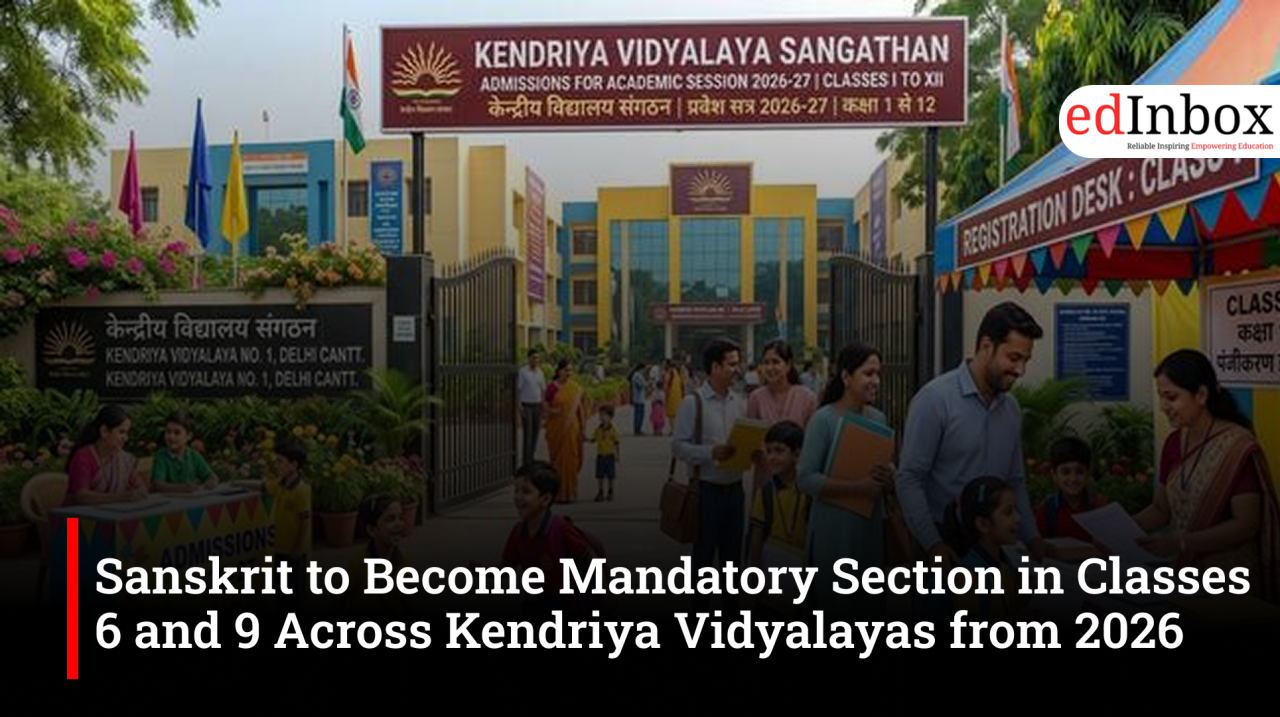
KVS directs all schools to offer at least one Sanskrit section under the three-language formula, aligning with NEP 2020 and CBSE's revised language policy.
The Kendriya Vidyalaya Sangathan (KVS) has announced that all Kendriya Vidyalayas across India and abroad will be required to run at least one Sanskrit section in Classes 6 and 9 from the 2026–27 academic session. The move is aimed at ensuring a common language option for students, particularly children of transferable central government employees, while remaining aligned with the three-language framework envisaged under the National Education Policy (NEP) 2020.
Under the new arrangement, Hindi and English will continue as the first two languages, while students will choose either Sanskrit or a scheduled regional language as their third language. Although Sanskrit sections will be compulsory for schools to offer, students will retain the freedom to opt for a regional language if they prefer.
According to KVS, the decision has been taken to address the educational needs of students whose families frequently relocate due to government service. A common Sanskrit option across all Kendriya Vidyalayas is expected to provide greater academic continuity and reduce disruptions caused by varying regional language offerings.
The implementation strategy will vary according to school size and student demand. In single-section schools, separate groups may be formed if at least 15 students choose Sanskrit or another language option. Multi-section schools will organise sections based on enrolment patterns and language preferences.
The rollout, however, may pose challenges for some schools, particularly those facing shortages of qualified Sanskrit teachers. To address staffing gaps, KVS is expected to explore contractual appointments and other temporary arrangements. Schools may also use State Council of Educational Research and Training (SCERT) materials where National Council of Educational Research and Training (NCERT) textbooks are not yet available.
The initiative is closely linked to the National Curriculum Framework for School Education (NCF-SE) 2023 and recent CBSE reforms. From July 1, CBSE requires Class 9 students to study three languages, including at least two Indian languages. Foreign languages may be offered only as additional subjects.
KVS officials said data collected through the Samagam portal will guide staffing requirements, section formation and timetable planning for the 2026–27 academic year. The move marks another step in the implementation of NEP 2020's vision of promoting multilingualism and strengthening the study of Indian languages in schools.