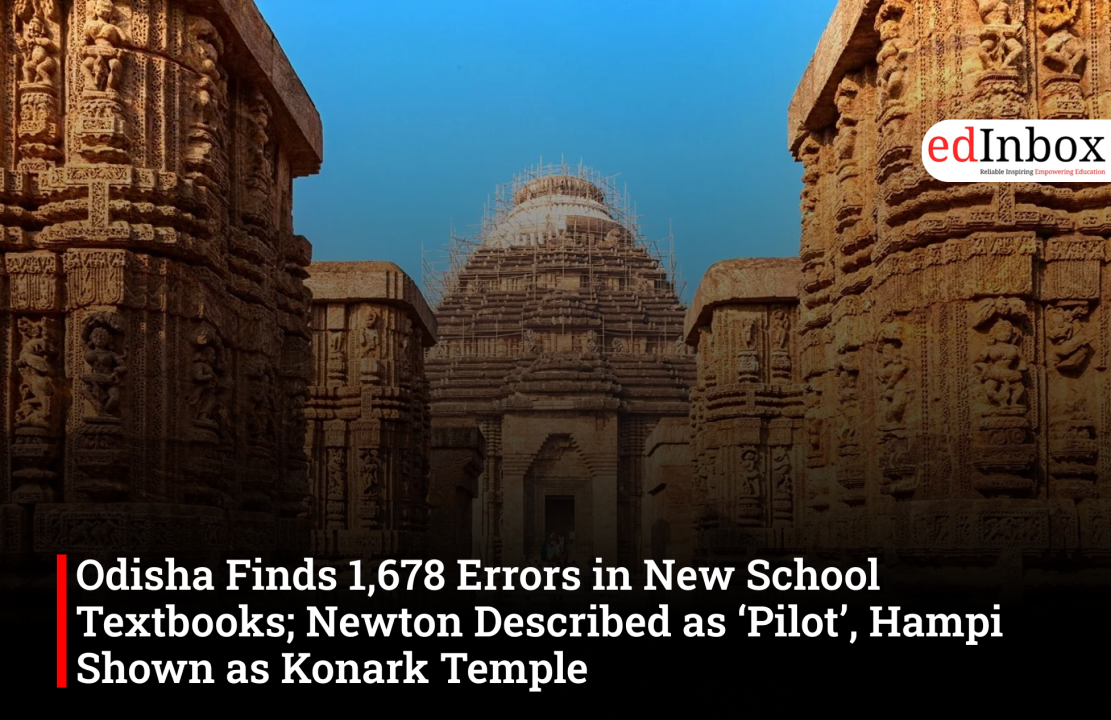
The Odisha government has identified 1,678 spelling, factual, grammatical and contextual errors in newly introduced Odia-medium textbooks for Classes I to VIII, triggering concerns over the quality of educational material developed under the National Education Policy (NEP) 2020 for the 2026-27 academic session.
The errors were detected in textbooks prepared by the State Council of Educational Research and Training and the Directorate of Teacher Education, which had undertaken a major curriculum revision aligned with the NEP framework.
The mistakes came to light after the books, delayed due to printing issues, were distributed to government schools. Teachers reviewing the textbooks reported a wide range of inaccuracies, from typographical errors to serious factual misrepresentations.
Among the most striking errors, renowned scientist Isaac Newton has been described as a “great pilot” instead of a scientist. Another passage incorrectly states that Newton boiled water rather than eggs, whereas the well-known anecdote refers to him mistakenly boiling his watch while absorbed in his work.
Several geographical and cultural inaccuracies have also been flagged. A photograph of the Vidhana Soudha in Karnataka was identified as the Odisha Legislative Assembly. Likewise, an image of the Hampi temple complex was used to represent the Konark Sun Temple.
Other mistakes include identifying Humma salt pans as being located in Berhampur district instead of Ganjam district and describing Niyamgiri Hills as a mountain range in Jharkhand rather than Odisha.
Errors were also reported across subjects such as mathematics, science, and geography. In some cases, wheat was written as paddy, glass as cup, temperature as pressure, food web as food cycle, and equinox as equator. Mistakes were found not only in Odia textbooks but also in Hindi, Sanskrit, English, and Urdu learning materials.
Odisha School and Mass Education Minister Nityananda Gond said the state government had introduced 55 new textbooks for Classes I to VIII based on NCERT guidelines after implementing NEP-2020. He acknowledged that the tight timeline for developing the books may have contributed to editing and printing errors.
“The books were prepared within a short period, which may have resulted in some printing and editing mistakes. We have identified the errors and the process of rectification is underway,” the minister said.
Officials from the School and Mass Education Department said all identified errors have been compiled and a corrigendum has already been issued to schools to ensure students are not adversely affected during the current academic year.
The episode has raised broader questions about textbook quality control and the review mechanisms employed during large-scale curriculum reforms, particularly when new educational policies are implemented within compressed timelines.