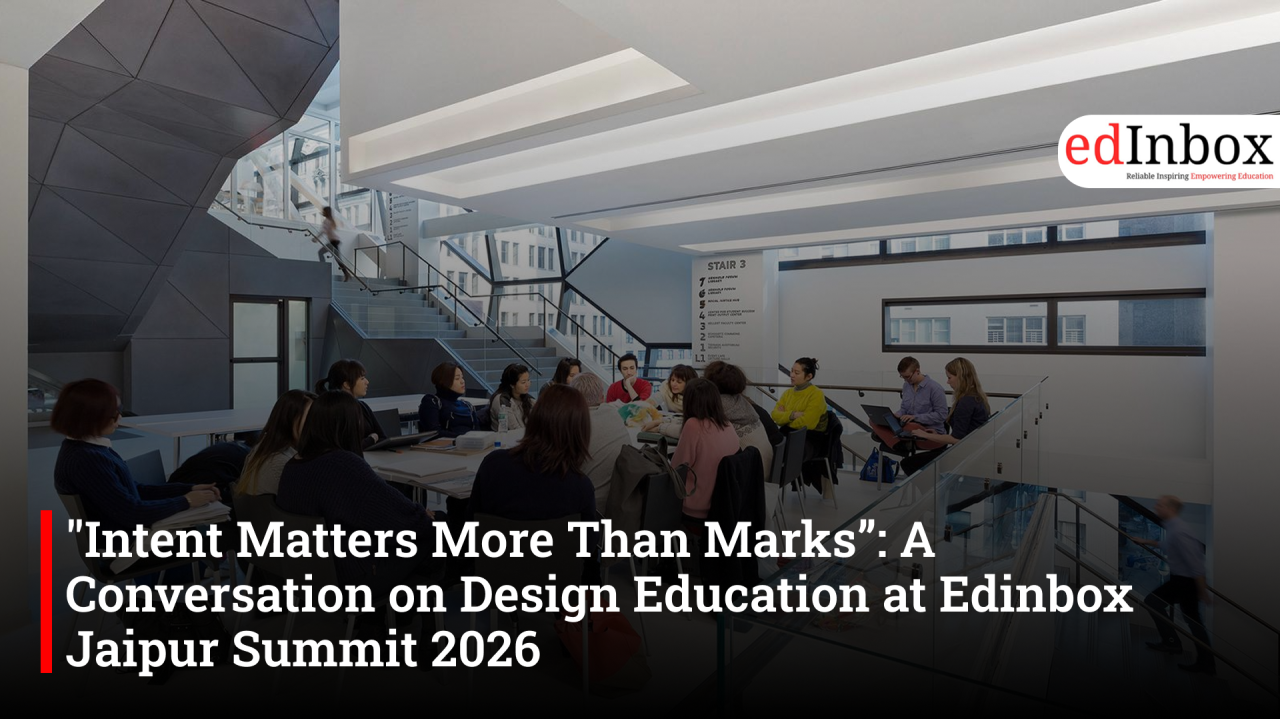
Design education is the study and application of principles of design in a lot of fields. Designers are taught to communicate and solve problems well, and are aware of how to produce visually successful designs using elements such as line, shape, color, type, and so much more.

Quality design education is crucial for a myriad of reasons, regardless of which area of design work a budding designer wishes to pursue.  A clearly defined design mindset saves businesses time, effort and money as it means they are significantly less likely to waste resources or even build the incorrect thing. One of the primary frameworks that helps teams and leaders develop these abilities is design thinking.

Designers are generally in groups and collaborate with different stakeholders and departments such as management, marketing, and development. Effective communication skills allow designers to convey their professional opinions clearly and always to represent the user. However, design is a form of communication. In a adecent education environment, designers know how to maximize expressing themselves, listening, and collaborating.

That is what enables them to go beyond assumptions or bias when working with the target group. After designers are aware of the needs of the users, they can design things that pull the users in. That is particularly important in fields like web and application design, where users instantly delete applications that fail to meet expectations.

A solid educational foundation enables designers to draw on valuable information and tools in an effort to design smooth interfaces. These will be what usher their users along their many micro- or sub-tasks as they try to accomplish their goals. For example, individuals in a target market who use a design are going to frequently be time-constrained. They'll typically be using mobile devices with one hand while distracted. They'll likely have a very low tolerance for lateness or bafflement. The individuals who created that app are going to have to entertain them, ideally, but at least not cause them to quit or be bemused. So bear in mind that designing any online product takes a lot of foresight, careful preparation and tightly managed time to prepare for this. With well-applied design knowledge, designers can, for example, develop useful personas, study user journeys, and engage in helpful journey mapping to address user needs. Then, they can invalidate or validate hypotheses regarding their users, uncover blind spots, and learn valuable insights through user testing.

With design education evolving in India are some of the major numbers and figures defining these changes both in India and internationally, so one may actually see where design education would stand five years down the line.

Cross-Disciplinary Learning and Collaboration

Cross-disciplinary methods and design thinking, as cited in a McKinsey report, enabled corporations to grow 30% beyond comparable-sized corporations and are critical elements in design education.

Emphasis on Sustainability and Social Responsibility

Circular Economy will be a $4.5 trillion industry by 2030 in the entire world, and that is a historic moment for design educationists to make the students learn green product design as thoroughly as green innovation. They want to be educated in such a way that they are able to come up with solutions to environmental and social issues and thus redefine the process of designing courses everywhere.

Adoption of New Technologies

Global Stats

The global AR/VR market is expected to reach $209.2 billion by 2027 with a CAGR of 18%. The trend is also affecting design education with schools and educational institutions adopting immersive technologies for interactive learning and prototyping.

 It is due to growing interest in AI-based design software within India. In the year 2023, 47% of Indian students choose to study design courses interested in learning AR/VR and AI technology as part of their course, according to a KPMG report, reflecting rising interest in technology-oriented courses in design.

Emphasis on Interactive and Digital Design

Global Figures:

According to Statista (2023), 75% of global companies today leave their web presence accessible to UX/UI design. Consequently, the demand for professionally qualified UX/UI designers rose more than 50% during the last three years.

The international UX/UI Design industry is anticipated to expand by 16% every year until it reaches a point when it will total $6.3 billion as of 2026.

Indian Scenario: The Indian UX/UI design industry increased at a compound annual growth rate of 22% for the past two years. Skilled UX/UI designers will see increased demand by 20% year over year in the coming years, as visualized by NASSCOM. According to a LinkedIn survey (2023), Indian students who were interested in studying design preferred to become a UX/UI design specialist by 60%, reflecting the need for interactive design training.

Global and Online Learning Experience

Global Statistics:

Worldwide online design courses have grown 100% over the past five years, and almost every design school has virtual classes, live classes, and global classroom experience, says Coursera.

Cross-Disciplinary Design Thinking Integration

Global Stats:

60% of the world's largest organizations (Apple, IBM, and Google included) have adopted design thinking as their main innovation and problem-solving strategy, a 2019 Stanford d.school survey found. It is bringing design thinking into mainstream education, outside the confines of traditional design disciplines.

Indian Context: Design Thinking is being made a central education paradigm in India, with institutions like the Design Foundation advancing its relevance in engineering, business, and health streams. It's projected that 50% of Indian centers of higher learning will have design thinking as a course by 2028, more in engineering and business management.

With the expansion in design education, interdisciplinarity in studies, emerging technology, and sustainability will be the force behind change. Design education is getting more adaptive, socially responsible, and technology-focused at global and Indian levels. The next five years have plenty to offer as regards expansion in the areas of AI, UX/UI design, sustainability, and knowledge transfer from other disciplines. By adopting such trends, design schools and instructors will ensure the next generation of designers are well prepared with the necessary skills and are able to deal with the challenges of an evolving world.

Explore UID's New Design Programs

The future of education is changing and dynamic, and United world Institute of Design has taken it upon themselves to equip students with the challenges of the future. Focused on future technologies, sustainability, and interdisciplinarity, UID is offering 21 advanced programs in 7 departments.

No matter which fashion design, communications, UX/UI, animation, or other designs one is interested in, UID has facilities and room for one to excel. Furthermore, our Global Design Program (GDP) offers students global exposure and experience to equip them with international design challenges.

Avani Institute of Design inaugurated Kerala's first integrated design programme — a five-year dual degree course that combines B.Des and M.Des. The programme is a landmark as the institute is completing a decade of academic achievement.

Integrated Design Program has multiple points of entry and exit as per the National Education Policy (NEP). The students can graduate with a Bachelor's degree within four years or go on to obtain a Master's degree in five years and thus offer flexibility at the cost of depth.

Product Design and Interior Design specializations balance broad learning with specialized, advanced industry-specific skills and foundational learning and prepare students to meet India's design industry's shifting requirements.

"The education in design today must go beyond the conventional limits," asserted Tony Joseph, Chairman and Principal of Avani Institute of Design. "This program demonstrates the way Avani believes that design is not so much about creating things or buildings, but about affecting ideas and solutions that can assist in changing a positive impact on society."

As a not-for-profit institution of higher learning, Avani has defined itself as more than a campus. Its NEP-mapped and world-charged curriculum combines architecture and design with liberal arts, philosophy, culture, and technology. 

Faculty note that the curriculum is designed such that it produces socially responsible designers, merging multidisciplinary learning with a value system that promotes community, culture, way of life, and economy. Balance between theory and practice, merging liberal studies, technology, and socio-cultural studies, the graduates become confident and possessing the skill set to succeed in rapidly changing industries.

Avani reiterates its dedication to the development of design leaders who are adept at creativity, critical thinking, and application in this revolutionary program in designing solutions that will matter tomorrow.

Chitkara International School (CIS) in Chandigarh and Panchkula became the first schools in North India to sign a Memorandum of Understanding (MoU) with the UK-based World Design Council (WDC).

Through such an alliance, CIS becomes an official learning partner of the WDC, signaling a new era of learning design in North India.

The MoU was executed by the top-level management such as Philip Thomas, India country head, WDC, and Vanessa Meister, senior fellow, WDC. It reaffirmed the manner in which the leadership for creativity and design would be needed to redefine the future of education.

With this partnership, CIS will be able to reform its education curriculum through the incorporation of the Future Creative Minds Programme—a holistic, global skilling program created by WDC. The program will aim to impart to the students the most critical skills such as design thinking, innovation, problem-solving, data analysis, AI literacy, sustainable behaviors, communication, and ethics.

The area of specialization is in enhancing the CBSE curriculum, and the program also consists of higher-level modules of studies, faculty seminars, and experiential workshops. The students will also receive exposure to international forums, thereby making them familiar with the international world and allowing them to expose their creative skills.

Niyati Chitkara, school education vice-president, said, "This alliance once again demonstrates our vision of graduating students with transformational skills to succeed in an accelerating, fast-changing world economy. As a WDC-accredited learning partner, we look forward to preparing our students to be innovative problem-solvers, innovators, and world-changing makers."

"For students, the program will enrich their portfolios for greater opportunities in post-secondary education, scholarships, and other career opportunities. The collaboration also promotes interdisciplinary thinking, utilizing science, technology, arts, and society, and increased real-world readiness and creativity," she further explained.

Top Bloggers

  • Sample avatar

    Christian Hardy

    Joomla! core

  • Sample avatar

    Agnes Payne

    Joomlart's Co-Founder

  • Sample avatar

    Christian Hardy

    UberTheme's CEO