
Texas A&M University cancels graduate ethics course over race and gender policy concerns
 Edinbox
 Blog
Edinbox
Edinbox Blog
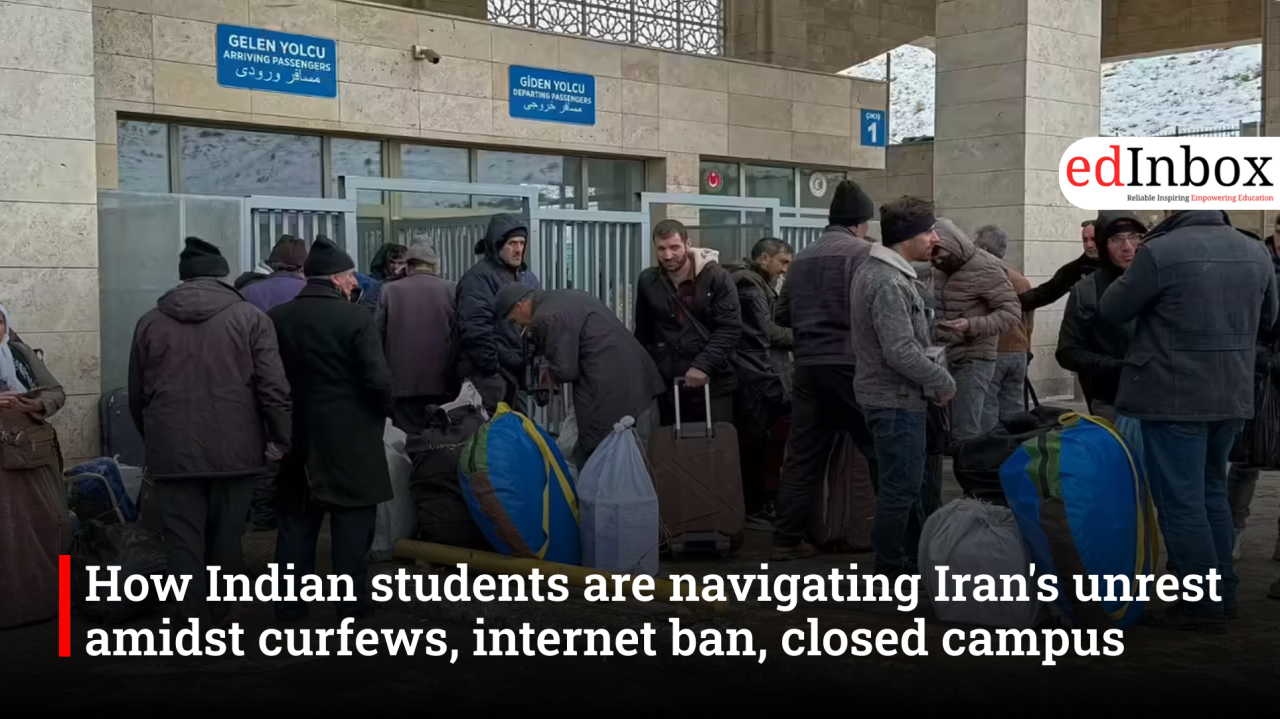
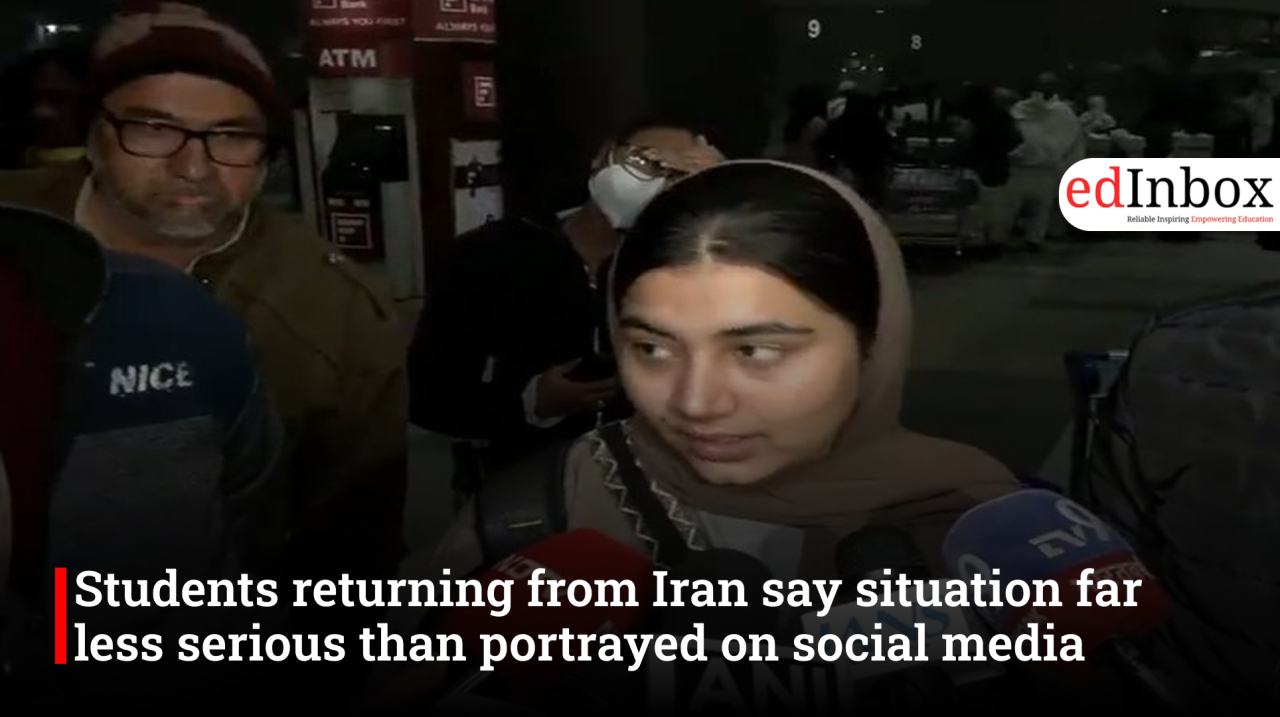
Several students who have come back from Iran told that the conditions there are normal and not as serious as it is being shown on social media. They emphasized that they did not see any protests and they were completely safe during their stay there.
Students mainly from medical and professional courses in Iran told the journalists that they learned about the protests through news and social media but the daily life in the cities where they lived was continuing without any disturbances. On the other hand, they said that the internet was not working, and there was no presence of fear either on the campuses or in the surrounding areas.
Several students stated that a large number of their classmates and fellow Indian students preferred to stay back in Iran and did not opt for
return, as academic activities were continuing normally. “We only heard about protests but never saw anything with our own eyes,” some of the returned students said, adding that social media narratives appeared exaggerated and misleading.
Parents of the returning students expressed relief over the safe arrival of their children and extended gratitude to the All-India Medical Students Association for its coordination and support during the process. They particularly thanked Dr Mohammad Moomin Khan, Vice President of AIMSA, for what they described as tireless efforts to ensure the students’ safe return.
“We are really thankful to AIMSA, especially Dr Mohammad Moomin Khan, who made every possible effort so that our children could return home safely,” parents said.
The students maintained that there was no panic on the ground in Iran and urged people to rely on verified information rather than unconfirmed social media content, which they said often amplifies fear without reflecting reality.

The Indian government will roll out a new PM Research Chair scheme to attract 120 global Indian scientists and researchers back to the Indian Institutes of Technology (IITs) over the next five years. Discussed during an IIT council meeting, this move aims to enhance the country's higher education and research ecosystem by involving top Indian-origin talent in the major sectors.
The PM Research Chair scheme has conferred on the research fellows the liberty to select their own research topic out of 14 themes of national importance. The Chair post holders will be Research fellows, Senior Research Fellows and Research Chairs. This will be a follow, up to the existing scheme of research chairs and will expand the scope of activities that research chairs can do. A Department of Education spokesman further revealed that the scheme is targeted at strengthening the research capacity of institutions, stimulating innovation, and thus, raising India's position on the world map in science and technology by the ministry of education.
The IIT Council, which is the highest coordinating body for the IITs, was informed about the proposal at its meeting held in August last year. It is seen as a strategic move to tap the global talent pool of Indian origin and to solve problems in India's higher education system like a limited number of specialisations and lack of internship opportunities. The Council believes that this scheme will attract top researchers and thus improve the research environment in IITs.
Besides the PM Research Chair initiative, the IIT Council has also suggested that a comprehensive survey be undertaken in all the 23 IITs to evaluate the alumni outcomes and the socioeconomic impact of the graduates from the 2013, 2014, and 2015 batches. Along with the survey, which will investigate the primary reasons for IIT graduates to study abroad, the Council has also proposed reforms in the MTech and PhD programmes such as increasing the number of industry internships and making specialisation more accessible. The implementation of these recommendations will be under the aegis of IIT Bombay.
Earlier, the Council discussed the necessity of updating MTech and PhD programmes to meet the requirements of the industry more closely. Internships are to be made a compulsory part of the MTech curriculum, which is one of the important changes that could increase the student intake in these programmes, as per the Council's suggestion.
The Prime Minister Research Visit, IIT Council has expressed its confidence that the scheme can bring significant changes in research capabilities of India. Along with the reforms that have been proposed, this initiative is a crucial step towards the betterment of the academic and research environment in India.

India wants to host more than one million international students by 2047.The new government-sponsored report presents the long-term view of how higher education is positioned as a key element of India's plan for future growth and development. While the projected and projected figures are encouraging, the report also shows that in order for India to be able to compete effectively with established global educational hubs, there are numerous serious structural deficiencies that must be overcome.
Titled "Internationalisation of Higher Education in India: Prospects, Potential and Policy Recommendations", the report was produced by NITI Aayog in cooperation with IIT Madras and the Association of Indian Universities. In addition to viewing international education as a source of income for the country, the report also views it as a means of soft power, a multiplier for research, and a method of redrawing India's position as a knowledge economy.
With more than 1,200 universities and close to 40 million students, India now has the second-largest higher education system in the world. Furthermore, according to many experts, the median age of the Indian population is slightly over 28 years, which is one of the youngest in the world. In spite of this, India's presence in the international student market has historically been quite small. Thus, in 2021-22, approximately 50,000 foreign students enrolled in Indian universities, whereas nearly 1.1 million Indians were studying in foreign countries.
Globally, countries such as the US, UK, Australia, Germany, and Canada treat international education as a strategic export. India, the report suggests, has largely functioned as a talent supplier rather than a destination. By 2022, Indian families were estimated to have spent nearly $47 billion on overseas education—a figure that is expected to rise if current trends continue.
The motivations are not hard to understand. Students seek stronger research ecosystems, global exposure, industry-aligned curricula, and smoother pathways to international careers. While India’s elite institutions enjoy global reputations, the broader university system struggles with uneven quality, limited international faculty, outdated syllabi, and weak global linkages.
The report projects that with sustained reforms, inbound international enrolment could reach 85,000–1.5 lakh by 2030, 3.6 lakh by 2035, and potentially between 3 lakh and 11 lakh by 2047. Achieving even the lower end of this range would mark a significant shift—from a country known for exporting students to one that attracts them.
According to the authors, the national Internationalization Strategy should focus on establishing Joint Degree Programs, supporting the mobility of International Faculty, creating Globally Benchmarked Curricula, and developing Research Partnerships. One of their most progressive proposals is to establish Regional Higher Education Hubs, much like those found in Singapore, the UAE, and other areas of Europe, which would serve as a destination for international campuses, conferences, and collaborative research centers.
The report highlighted that India is lacking in the area of research. Despite the large number of publications coming from India, the majority are cited from a very small number of prestigious institutions, limiting India's global collaboration potential. Without developing a stronger research ecosystem, it will be difficult for India to gain access to Doctoral Students, Global Faculty and Innovation-Driven Investments.
Throughout the document, the authors made reference to India's ancient centres of learning such as Nalanda, Takshashila, and Vikramshila, serving as a reminder that global education has a long history in the Indian subcontinent. What is new is the scale of competition.
By 2047, India faces a choice: remain a net exporter of talent or rebuild universities that draw the world in. The ambition is bold. Whether the system can reform fast enough to match it remains an open question.
An expert clarifies the reasons for a large number of Indian students who are looking to study abroad in 2026, the first four countries that come to their mind are the United States, the United Kingdom, Canada, and Australia. However, New Zealand keeps receiving good number of applications from outside that group. Its attractiveness is not based on the large number of people or on something grand. It is based on the fact that it is a predictable, well, organized and outcome, oriented country. "In terms of work, life balance, New Zealand is ranked number one in the world, " said Piyush Kumar, Regional Director for South Asia, Canada and Latin America at IDP Education. "It is a small country with only 8 universities, but all of them are in the top 2% universities in the world according to the QS rankings, " he added. This framework determines how students feel about the system. Since there are only 8 public universities, the range of choice is limited but more obvious. Students are not confronted with a large number of institutions which have poor outcomes. Instead, the system ensures that preferences made on different campuses are consistent in terms of academic standards as well as student support.
Who New Zealand suits best New Zealand is a suitable destination for students who prefer a manageable approach rather than a large, scale one. The country does not have as many institutions or programmes as bigger destinations. What it does have is a lot more straightforward. It is easier to figure out from the very beginning the access requirements, the academic expectations, and the options after the study. Kumar highlights lifestyle as the main factor for retention. Great work, life balance, he said, naming one of the most commonly cited reasons for the choice of the country by students. For Indian students, especially those doing postgraduate studies, this balance usually means less burnout and a more stable routine during the study. Courses driving Indian interest Choice of programmes among Indian students is mainly based on the practicality of the subject. Kumar says, to name a few, top areas of student interest are information technology, environmental sciences, business programmes, and hospitality. These areas not only match with New Zealand's domestic skills needs but also in the sectors where students can do part time jobs during their studies. Environmental sciences become a significant pull factor for the students as a new area. As issues like climate change, sustainability, and resource management are becoming more and more important worldwide, New Zealand's academic focus in these areas is getting students who are looking beyond the usual business or technology tracks.
Policy stability or stability in immigration law and policy plays a central role in New Zealand continued appeal.
New Zealand offers three years of post study work rights, a factor that strongly shapes student decisions.
That is the thing because, for many Indian families, post study work is not an optional benefit. It is part of the return, on, investment calculation.
Just as important is the absence of constant bouncing back of policy. While other destinations have changed student visa rules, dependent eligibility, or work conditions in short cycles, New Zealands framework has remained comparatively steady. This lowers the risk of planning over two or three years of an academic journey.
Safety is another element that retains the interest of the public. New Zealand ranks highly on personal safety indicators, and its smaller cities often are less overwhelming for first, time international students. For parents who are deciding on the destination while staying at home, this predictability matters.
Merged with structured arrival and orientation systems at universities, the overall environment seems to be designed rather than done by chance. For students who are moving abroad for the first time, that difference is noticeable.
An option that stays under the radar New Zealands study, abroad appeal is not the result of loud marketing or high figures. It stays very much under the radar, and perhaps that is the reason why it is so often called an underrated destination. However, the country remains to be on the 2026 map for those students who, among other things, value a balanced lifestyle, straightforward post, study pathways, and institutional consistency.
As per Kumars evaluation, New Zealand is not changing its strategy to fit everyones needs. It is providing a single, clear proposition. For some Indian students, this clarity is exactly the point.