In 2026, Gujarat plans to take a revolutionary step in not only deepening artificial intelligence (AI) research and development but also fast AI, driven national ecosystem. The Chief Minister Bhupendra Patel has given a nod to the establishment of the Indian AI Research Organization (IAIRO) through a tripartite partnership, including the State Government, the Government of India, and the Indian Pharmaceutical Alliance (IPA). The state government of Gujarat says it is becoming the first state in the country to establish the IAIRO under the PPP model. This IAIRO will be launched as a Special Purpose Vehicle in GIFT City from January 1, 2026. It will be established as a non, profit institute under Section 8 of the Companies Act, 2013. Besides, an approximate budget of Rs 300 crore has been earmarked for the initial five years of the project, wherein the State Government, the Central Government, and the private partner will share the contribution equally, i.e., 33.33 per cent each.

Gujarat government in its statement mentioned the Indian Pharmaceutical Alliance also has taken a lead role as the anchor private partner for IAIRO and will contribute Rs 25 crore for the year 2025, 26. The state government also added that IPA represents the conglomerate of approximately 23 major pharmaceutical companies, which include Cipla, Torrent Pharma, and Sun Pharma. Alignment with National and State AI Missions The program of Gujarat State perfectly fit the criteria set out by the India AI Mission of the Ministry of Information Technology, Government of India as well as the AI Action Plan of the State Government's Science and Technology Department. To accelerate sustainable development by such means as the use of AI technology in health care, education, and agriculture sectors, thee State Government set up an AI Task Force under the leadership of Chief Minister Patel. The aim is to furnish the quality of life of many people for the next generations. IAIRO's Core Activities and Vision IAIRO is additionally thinking ahead and as a result is expected to become a transdisciplinary hub for AI located in the area of Gujarat. The essential elements of IAIRO will extend significantly into the future with the lab ultimately conducting cutting, edge research and development in artificial intelligence and the development of novel AI, based products and processes. Moreover, the academic institutions, industries, startups, and government entities will be IAIRO's collaboration partners. Besides, IAIRO will focus on intellectual property (IP) creation, capacity building, and policy, based

Operational Framework

IAIRO will operate using a hybrid compute model that will combine GPU infrastructure available on premise with national platforms like the IndiaAI Cloud.

Projected Impact and Goals

The project aims to train a competent AI workforce that is ready for the future. India will also be positioned as a leader who can compete globally in the AI sector. As a result, Gujarat will gain more prominence as a technology and innovation hub of the future.

A fascinating new player in the offshore market is Japan, with world-class universities, increasing English language delivery, and a scholarship system in place to keep the price tag manageable for Indians. With the cost of studying abroad soaring in traditional destinations such as the US, the UK, or Australia, Japan is poised as the alternative of the future.

The Study in Japan (South Asia) project, initiated by the University of Tokyo and Acumen, has resulted in a considerable expansion of outreach activities in India. Today, over 25,000 students in over 100 Indian cities have had interactions with Japanese universities via education fairs, as well as online engagement through Navi Japan, an interface initiated by Study in Japan, connecting students directly to universities, as well as to current students and authentic information on available studies and scholarships.

Despite this spate of interest, the numbers of Indian students in Japan remain relatively low—at approximately 2,000 students at the undergraduate, master’s, and research levels—indicating considerable potential for expansion.

Multiple Study Pathways for Indian Students

1. Exchange and semester programmes

Many Indian students begin their Japan journey through semester-long or year-long exchange programmes enabled by institutional partnerships. These allow students to earn credits in Japan that count toward their Indian degree.

For instance, OP Jindal Global University’s partnership with the University of Tokyo facilitates structured exchanges and short-term academic programmes. Similar collaborations exist with IIT Mandi, IIT Guwahati, IIT Hyderabad, JNU and SRM University.

2. Short-term programmes and summer schools

Japanese universities offer two-to-six-week summer and winter schools, often focused on technology, sustainability, business, public policy and Japanese culture. These programmes appeal to students seeking international exposure without committing to a full degree abroad.

3. Research internships

For students in science, engineering and the humanities, research internships at Japanese labs and centres serve as a strong entry point—especially for those considering PhD programmes or research-driven careers.

4. Joint and dual degree programmes

Joint and dual degree options—where students study in both countries and earn recognised degrees—are still limited but expanding steadily as India–Japan academic cooperation deepens.

Scholarships That Make Studying in Japan Affordable

One of Japan’s biggest advantages is its well-structured scholarship ecosystem, which significantly reduces the financial burden on international students.

MEXT (Monbukagakusho) Scholarship

The Government of Japan’s flagship scholarship covers:

  • Full tuition fees
  • Monthly living allowance
  • Return airfare
  • Preparatory Japanese language training (if required)

Available for undergraduate, postgraduate and research students, MEXT is highly competitive—but Indian selections have been steadily increasing.

JASSO Scholarships

The Japan Student Services Organization (JASSO) provides monthly stipends, particularly for exchange students. While these may not cover full tuition, they help offset living expenses.

University and private scholarships

Many Japanese universities offer merit-based fee waivers, tuition reductions and internal scholarships. Additionally, private foundations provide funding options that students can apply for after enrolment.

Cost of Studying and Living in Japan (Approximate)

Tuition fees

At public universities, annual tuition averages ¥535,800, roughly ₹3–3.2 lakh per year. Private universities may charge higher fees.

Living costs

Students typically spend ¥80,000–¥120,000 per month (approximately ₹45,000–₹70,000), covering rent, food, transport and utilities. While cities like Tokyo are more expensive, regional cities are significantly more affordable.

Part-time work

International students are allowed to work part-time, which many use to supplement their living expenses.

Campus Life and Cultural Adjustment

Japan is widely regarded as one of the safest and most efficient countries in the world. Clean cities, reliable public transport and low crime rates contribute to a high quality of student life.

That said, cultural adjustment is real. Communication styles are more indirect, punctuality is strictly observed, and social norms may feel unfamiliar initially. Most Indian students, however, report that once settled, Japan offers a deeply enriching campus experience—marked by academic rigour, vibrant student clubs, festivals and travel opportunities.

Is Learning Japanese Necessary?

While many degree programmes are taught in English, learning Japanese is strongly recommended. Language skills help students navigate daily life, integrate socially, access internships and part-time jobs, and improve post-study employment prospects.

Students can learn Japanese through:

  • University language courses (in India or Japan)
  • Online platforms and apps
  • Short-term intensive language programmes
  • On-campus language labs now being introduced at some Indian universities

For Japanese-taught programmes, students may need to clear JLPT (Japanese Language Proficiency Test) levels. Higher JLPT scores significantly enhance academic and career opportunities.

Why Japan Matters for India’s Higher Education Future

With over 150 active India–Japan university partnerships, collaboration is expanding across research, innovation and student mobility. Japan’s emphasis on technology, research and interdisciplinary learning aligns closely with India’s higher education and skilling goals.

For Indian students, Japan offers a rare combination: globally ranked universities, strong industry linkages, cultural depth and relative affordability—without the escalating costs and visa uncertainties increasingly associated with Western destinations.

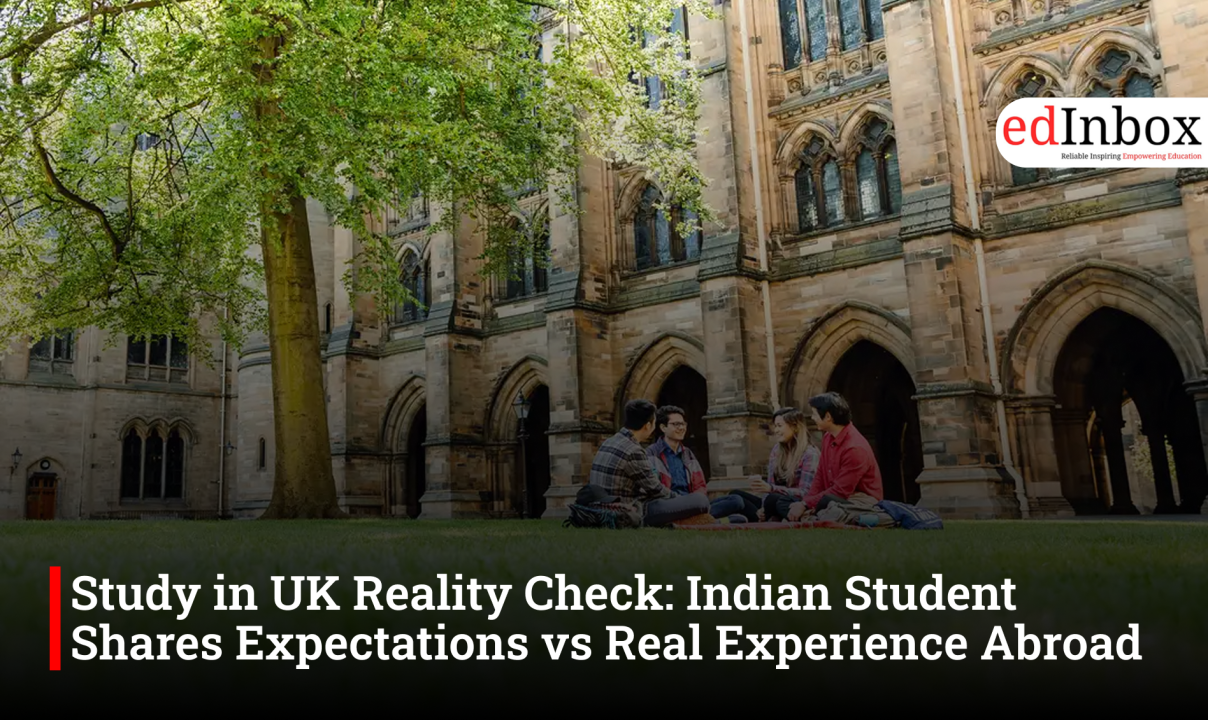
It is the excitement that normally comes with the decision to pursue higher education abroad. Many Indian students feel that they are embarking on a new life that they had hitherto only experienced remotely, but never personally. Neeharika, the Master of Science in Business Analytics student at Durham University in the United Kingdom, encapsulates her transformation with the words that come across as "déjà vu" to so many others: “It is that moment you realize your life now has two homes and two versions of you.” The phrase accurately captures the journey that all the students face who leave home for something greater.

Neeharika’s is a “suite case that refused to close,” friends trying not to cry, and parents spouting reminders that she had memorized in her sleep. At the airport, she felt “torn between two opposite emotions. One part of her was scared to leave behind all she had known. Another part of her was thrilled with the prospect of discovering who she could become." This contrasted feeling follows her on her plane.

Lesson for the aspiring student: The first thing you have to learn is moving away from home, and that is something more than relocation, it’s transformation of oneself. Both preparations are geared towards equipping you with more stable expectations when you embark on the process.

Entrance to the quieter world

As Neeharka settled into the UK, the first culture shock did not relate to climate either. "The first thing that struck me wasn’t the cold. It was the quietness. The lack of pressure cooker whistles in the kitchen, no honking of rickshaws outside, no calls from across the balcony.” The strangeness of this quietness made it feel even more far off than when he left his homeland.

The first experiences in a foreign land are always one of getting used to. According to her, “It was like learning to walk again. Every single thing in life was different. The mode of transportation, the food, the accents, even the way people smiled.” Doing grocery shopping was a weekly struggle. According to her, “Deciding which veggies to choose in a foreign land was like a whole semester course nobody told me about.” It is in these kinds of small struggles that the first education for independence is achieved.

Students planning to study abroad, or even those just considering it, might find that they believe that the most significant challenges will lie in their academic pursuits. However, it's the small things in life that will teach you far too much as well.

Learning to navigate these small transitions in life without judging yourself is, in fact, one of the earliest activities you undertake as you claim your independence.

Learning within a system that expects more from you

Life at university brought a whole new range of adjustments. It came with a different teaching method: the skills and responsibilities of carrying a student's education were placed in their hands. Her routine included a pattern that will seem very familiar to international students: cooking in the morning, attending lectures, and in some cases socializing and pulling late nighters. “Assignments were tougher, conversations were more open and ended with every class having students from different countries with different perspectives.” Some days she could feel invincible, while on other days she felt clueless. "Both were equally significant in making me."

So, for the benefit of future students, this is worth sharing. Trust me, you won't always feel like you're capable enough. The education patterns there are totally self-managing, and it takes some time to adjust to it, though. Feeling lost is not the end; it's just a process that every international student has to go through.

Identify individuals who transform into a home.

There were also changes that came from her personal connections. She had assumed that making friends would not come easy if she moved abroad. However, she found that people just seemed to show up when she needed them the most. There was the friend that she met in classes whom she had asked if she could sit with because they came from the same country. There was also another friend who called her out of the blue because the sky is beautiful outside, and she said, ‘Aurora outside! Come now!’ There was also another friend who is equally keen on visiting all the Harry Potter sites that were shot.

These friendships, she asserts, were no coincidence, and they formed the foundation of the network of support and encouragement which saw her through homesickness, deadlines, and long nights. “You don’t simply find a community living in another country. You create one, bit by bit, memory by memory,” she has come to realize.

Then too, there is something in it for those students who may fear the loneliness of the halls. Community does not simply appear out of thin air on the first day of school. It begins to evolve, through experiences, through conversations. Aspiring students must have faith in the process.

The Real Rhythm of Student Life Abroad

 Being a foreign student can be romanticized, but this girl shows what it’s been like to be one. It means being awoken at odd hours of the night, having to cook because there's no choice, budgeting to the last penny, doing your laundry and carrying it from floor to floor in your residence, learning while half-asleep. But it's these small things that you hold onto. Walking back to your residence, exhausted from your day, and thinking, "I’m actually doing this. I’m constructing a life overseas." These, she asserts, are the highlights of studying abroad that will not appear on the highlight reel that students will look back on, because “The reality is that life is made up of everyday moments, not just the extraordinary ones, and it’s not always easy.” For students wishing to go abroad, she offers this balance to keep in perspective, “The reality is that life is made up of everyday moments, not just the extraordinary ones, and it’s not always easy.” Growth in silence “Growth is not loud or dramatic,” she says. “It is slow, subtle and often invisible until the day you look back and realise you have changed in the best possible ways.” It taught her to trust her instincts and understand the concept of resilience.

Her experience within the UK changed her perceptions of home and introduced her to the reality that the world is much bigger and much kinder than what she was brought up to think was her world. This is one of the most important takeaways for students planning to study internationally: growth isn’t immediate. It happens quietly in the background while you are busy adapting and coping and figuring out your universe. It might not seem apparent the first week on or sometimes not within the first month of your adaptation period. 

Growth typically reveals itself through small, almost unnoticed incidents. The fact that you have just managed to have a day without having to go back for your smartphone from the bus, or managing to cook a meal that actually contains real flavor. It might seem like small stuff, but trust her, this means that you are establishing yourself within a place that was previously unfamiliar to you. For students planning on heading overseas, it might be good to keep in mind that confidence develops slowly. It means you won’t be rocking up to your destination fully prepared to take on the world; rather, you would’ve prepared yourself for the challenge of living day by day. 

The philosophy taken forward: 

The question of whether or not the journey is difficult? The straightforward answer is yes. However, when asked if the journey was worth it, she gives a much more passionate “Absolutely yes. Every single day.” As a last piece of advice to people who are on the fence, she suggests, “Your story begins the moment you gather the courage to take that first step.” As a part of her departing advice to people heading overseas, this would perhaps be the most crucial for students to absorb from her experience. The difficult part of the journey would be temporary, and the growth and change that would happen would remain for a lifetime.

Another feud has flared up between Demis Hassabis and Yann LeCun, thereby breathing fresh life into the possibilities of Artificial General Intelligence. Artificial General Intelligence, also abbreviated as AGI, has been in the limelight ever since the ChatGPT blast in 2022. Demis Hassabis, the CEO of the DeepMind AI company, has only launched a verbal attack on Yann LeCun, an NYU professor, former head of Meta AI, and well-known as the ‘godfather of AI’.

Dispute arose when Yann LeCun gave an interview for a podcast, where he said that the idea of general intelligence was rubbish, to say the least. He also said that human intelligence is specific and has nothing to do with general issues regarding the world around them physically and that people's idea of AGI is an illusion.

"But, as Lecun continued, "people seem to be so flexible, human intelligence is not as good as we are oblivious to, we are not able to tackle all the problems that we encounter every day." To this, Google DeepMind’s CEO, Demis Hassabis, remarked, "Yann was simply wrong in saying this, confusing general intelligence with universal intelligence."

"The thing about generality is that, theoretically, within the Turing machine model for the definition of computability, its architecture is capable of computing or learning anything within some time bounds and some amount of memory space, and this applies to the human brain or models of AI which approximate a Turing machine," said Hassabis.

The significance of this is that Hassabis’ insight is that simply because one cannot do all things, this does not mean that there is not a use for something such as general intelligence. Again, predictably, mention of words is not overlooked by other leaders in this field, this time Elon Musk. Thoughts of Hassabis are shared again, saying that Musk declared that Hassabis was right.

There is an issue with AGI, which is:

As Yann LeCun says, “Artificial General Intelligence” or “AGI” is “a kind of intelligence that could match or even surpass human intelligence, according to a definition used by the organizations OpenAI or Google, et cetera, a system capable of dealing with brand new situations, adapting to unexpected events, or even improvising in real time, rather than relying for solutions solely on patterns discovered through learning, when, if ever, such a feat occurs.” “Artificial General Intelligence ” or “AGI,” is a definition for a type of intelligence that "corresponds to or even exceeds human intelligence combined" as a definition from the artificial intelligence companies, OpenAI, and Google, referring to a type of intelligence that is "capable of solving entirely new problems, adapting to However, as pointed out by Le Cun, all this is far from being a reality at present. This is because, despite being able to solve complex tasks, including passing highly difficult exams, as evidenced by chatbots such as ChatGPT and Gemini, these are still far from reaching human intelligence. This is due to their highly specialized nature that lacks the adaptability that human intelligence possesses.

Making plans for sending your child abroad for higher education in 2026? We have all already brainstormed over our finances, visas, scholarships, and procedure of entry by now. What is, however, being discussed in the Indian context has changed from rankings and popular choices.

Today, the focus is firmly on return on investment, employability, affordability, safety, and career outcomes.

These five questions that the parents are considering prior to applying to any institution in 2026 consist of:

 Q1. Are you applying to a degree that involves a foundation year? What are job opportunities and outcomes?

Answer: By 2026, having a degree will not be a guarantee of a job. Job opportunities following study will be dependent on the relevance of study programs, work visas, and opportunity following completion of the course.

There is also a need for parents to pay attention to recruitment rates while considering outcomes related to recruitment positions obtained by graduates, timescales for recruitment, and median recruitment salaries. Universities/Colleges which display recruitment information for graduates have improved outcomes compared to others who just rely on marketing or advertising. There is also a benefit for inclusion of recruitment program outcomes related to internships, cooperative years, project years, and industrial research years.

Top educational institutions are also spending heavily on career services. OneStep Global is currently working on the alumni career success teams of universities such as the University of Birmingham and the University of Glasgow in the Indian subcontinent. Their offerings include international recruitment readiness.

However, it’s also a good point for parents to be aware of the concept of career momentum, over and above the entry-level occupation. A good program would provide the building of skills, networks, and toughness that can accrue with age.

Q2. How credible or renowned is the university or the program?

Answer: "Rankings no longer decide credibility. Parents demand recognition from employers and accreditation and acceptance from regulatory authorities, especially since they would be sending students back to India and also may operate in other geographies."

Program-level verification is of utmost importance in fields such as the medical, and other connected fields, public health, and management. It holds more significance than just the market value derived by the brand.

In the “Student Perception Study Report 2025” by One Step Global, it is highlighted that there has been an increase in Indian families’ trust in alumni outcomes, peer advice, and counselor advice than advertisement-based communication for other countries such as Ireland.

Q3. What is the total cost each year for tuition and related expenses?

Answer: Tuition represents just one aspect of it. Other factors, such as the cost of living, residence, insurance, visa fees, transport, and exchange rates, have a deep impact on it.

It has to be factored in, budget-wise, by parents and not only on a country-wise basis, but on a city-wise basis. Although being affordable, along with industry accessibility for internships and part-time jobs, turns out to be an important criterion, a place which is less costly translates into less exposure, which could have a negative effect in the end.

The value of investment in educating members of households is also being re-evaluated. The value may be increased with programs involving paid internships.

Financial planning would have to incorporate contingency planning for potential increases in rents or changes in policies. Scholarships or part-time employment would have to be factored in, but not expected.

Q4. How safe and welcoming does your campus feel?

Answer: The issue of safety at the educational institution is more extensive for students in 2026 compared to the safety being referred to in the question when the question is interpreted literally.

Assessment of the accessibility of academic advisory, counseling, tutoring, and international services, especially in the first-year experience, is recommended. The significance of the transition process in the success of the academic experience cannot be overstated.

Interacting with students is also a critical factor. Reaching out to people beyond the normal social interactions helps improve communication skills and instills confidence needed by global companies.

Second, it is accommodation. Campus or reviewed by university housing would be better for monitoring purposes. Appropriate communication in terms of health care facilities, safety procedures, and emergency response would be required.

A safe campus is a campus with great institutional policies and a great student culture. 

Q5. Where are the opportunities for skill development, internships, or experience? 

Answer: Today, employability is based on skills and exposure, and not academics. Effective universities and institutions are those that integrate internship programs, industry projects, research, and work-integrated learning programs into their curriculum. These programs help students in learning to implement theories in practice and make informed career decisions. 

In addition to learning skills and abilities attained through education, the following skills will be sought:

  •      Problem-solving skills and abilities that can be applied to different scenarios;
  •      Information and communication technology literacy;
  •      Communication skills – written and verbal communication;
  •      Inter-cultural competencies.
  •      Colleges and universities that engage students in career counseling and job market solutions

It has been declared by the PIAI, which is the executive committee for the IIT alumni in India, that the dates for the Pan IIT Global Leadership summit, 2026 have been fixed. This summit will take place on the 20th and 21st of June, 2026, inside the "Yashobhoomi Convention Centre" located in New Delhi, with an overall vision to provide a podium for the largest gathering for global visionaries from the domains of technology, investment, governance, and diplomacy.

 The main focus of the event  will be to discuss the future roadmap for the global supremacy of India’s economy. The two-day conference is set to witness the presence of over 5,000 IIT Alumni, as well as world-class leaders, along with a massive influx of international delegates. This vibrant meeting forum, conceptualized for thought-recommending development, would involve the participation of 500 CXOs/Master Delegates, 200 international investors, as well as VCs, and over 100 speakers/policymakers from over 100 countries.

However, speaking from the point of a robust base for the organization, Er. Kamendra Kumar, a founder member of PIAI, and a renowned alumnus from IIT Roorkee, said, "The event named ‘Rising Rajasthan’ was also executed successfully in November 2025. There are chances for such events happening in Chennai, Agra, and Bangalore in India prior to the ultimate meeting happening in Delhi.” Commenting upon the performance point for the current PIAI organization team, Er. Kamendra Kumar said, "The new youth-based PIAI organization is headed by ‘very dynamic’ Er. Prabhat Kumar and ‘very dynamic’ Er. Ashok Kumar, who are ‘moving the organization towards ‘bigger heights.’ 

Apart from this, there would be other such sessions happening, such as keynote international sessions, panel discussions, leadership labs, policy roundtables, venture funding forums, investor & M and A lounges, start-up shows, as well as ‘networking sessions,’ focusing upon ‘actionable takeaways’ for every delegate. Some of the major ‘domains’ which have been selected for presentation for this meeting would include ‘artificial intelligence, ‘semiconductor design, ‘fintech, ‘climate ‘tech, and ‘space engineering ‘domains. PAN IIT Global Lecture Series 2026 would ‘moderate this meeting’ under Gourav Goel, who would serve as a moderator, from IIT Delhi, with Ashish Shandilya as Co-Chair.

In its efforts to reformat the way through which leaders must be trained in the 21st century, the Bharatiya Engineering Science and Technology Innovation University has allied itself with the India Foundation to open the School of Global Leadership, SoGL, today at ITC Maurya. This institution will seek to generate leaders to succeed in a diverse and dynamically shifting world.

It included in its ambit important decision-makers, former diplomats, university chancellors, representatives of various sectors, and youth professionals, which en masse can be seen to especially emphasize in their definition various stakeholders for SoGL to include in its ambit. Moreover, there was emphasis placed upon the challenges in this generation being allowed to move across various sectors such as governance, business, and technology and so on, which in turn requires decision-makers to be capable across various institutions and not be constrained within the lines of their own particular sector.

Pradhan identifies the constraints of the conventional leadership development process.

“The School of Global Leadership bridges the gap which exists in the classical leadership education programmes, wherein the more focus is on equipping tools and tactics rather than developing leaders equipped to manage uncertainty, systems, and tangible decisions," Education Minister Dharmendra Pradhan was quoted as saying on the occasion.

 “It thinks of leadership as an intellectual discipline as well as a practitioners’ discipline wherein it concentrates on developing systems thinkers, ethical leaders, and idea doers," he added.

Ex-MP & Ex-Chair SoGL, Dr. Jayant Sinha said, "SoGL, founded by BESTIU, a university retained by UGC, in collaboration with the India Foundation, Knowledge Partners, remains deeply rooted in the Indian experience of development & civilization, even as it remains engaged in the ongoing discourse on leadership across the world. Simply because the deepest learning on the topic of leadership has, in recent years, come to us from societies which are, in their own fashion, grappling with problems of size, diversity, & the speed of change." SoGL offers one-year PGP-GL with global residency programs One of the hallmark features of the SoGL program is that it is driven by practitioners, policymakers, entrepreneurs, and innovators, who, together with the faculties of the institution, ensure that the program is driven by policy interventions, knowing that knowledge is everything but implementation is everything else. 

Additionally, launched during the inauguration event is the key program of the SoGL, which is the Post Graduate Programme in Global Leadership, or PGP-GL, a one-year, full-time program that involves residency programs across the world, including India, China, UAE, USA, Italy, Belgium, and the Netherlands. The program’s learning outcome tracks a combination of governance, strategy, public policy, innovation, and ethics, with real-world learning import through engagement with real-world challenges that exist within the world of practice. Leadership, application, and SoGL emphasize that at SoGL, learning applications entail highlighting the ability to sense complexity, judge, and create institutions that work for the public. Learning paths include entering the immersive global labs, innovation immersions, and the future-tech policy labs where novel ideas produced from the world of knowledge are constantly being checked-out against the world of applications. Given these conditions, the BESTIU and the India Foundation recognizes that the SoGL is a disruptor within the mainstream paradigm for global leadership education—a generation that is capable of dealing with complexity, exercising powers responsibly, and generating resilient futures for inclusive growth.

More Articles ...